Archive | Blog RSS feed for this section

The laws of physics are non-negotiable

“Michel Jarraud of the World Meteorological Organization said that carbon dioxide levels increased more between 2012 and 2013 than during any other year since 1984.” reports the CBC today.

“We know without any doubt that our climate is changing and our weather is becoming more extreme due to human activities such as the burning of fossil fuels,” said WMO Secretary-General Michel Jarraud in a statement accompanying the WMO’s annual Greenhouse Gas Bulletin.

“Past, present and future CO2 emissions will have a cumulative impact on both global warming and ocean acidification. The laws of physics are non-negotiable,” Jarraud said. “We are running out of time.”

Pastiche Architecture posted on GBA!

We’re in again this month! Check out our blog post on Pastiche Architecture! Click the icon below to read the pictorial blog:

Posted September 9 in the Guest Blog section. Feel free to leave a comment.

FourSevenFive has Great Free CAD Details

If you’re not too sure how to tackle some finicky details, have a look through 475′s construction detail offerings for both new and Deep Energy Retrofits. Yes, they are pushing the line of products they sell, but there’s lots of options for pushing efficiency in all kinds of buildings. Click on the logo below:


475 High Performance Building Supply


I downloaded the Deep Energy Retrofit (DER): Historic Masonry, Climate Zones 4-8 and you can see the type of detail that apples in this case:

Though different than the typical residential double brick, there are similarities like the mud sill on the stone foundation wall.

The offer of 475 to give this information away is dammed generous! Thank you!

Origami Design in GBA!

Our blog post “Do Origami-Inspired Homes Perform?” got a make-over and is currently gracing  Green Building Advisor’s ‘Guest Blog’ pages, have a look!

A big thanks to Editor Martin Holladay for his editing genius!

BGG Seminar @ HomeBuilder Renovator Expo

With increasingly higher demand year after year, Ed Marion and BGG are proud to present again at the HomeBuilder Renovator Expo this year on Thursday December 4th at 2:30.

Our talk “Achieving Greater Energy Savings Through Powerful Building Envelope Design” will be updated to reflect all we’ve learned in the intervening year and we hope to see you there!


Deep Dish Retrofits Served Hot by Lstiburek

For those of you considering a Deep Energy Retrofit of a solid masonry home, the folks at Building Science Corp offer a simple paper that covers many of the details that keep Torontonians awake at night. As Dr Lstiburek says in the foot notes, Chris Benedict has been doing DER of solid masonry buildings for years now in NY and is considered a pioneer in the ‘industry.’

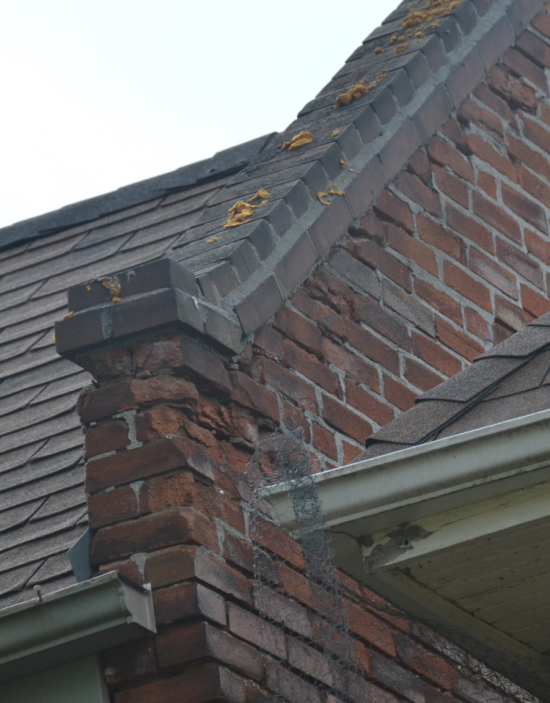
Parapet

This is an example of a typical Toronto home parapet. Most homes don’t have this feature, but a combination of rafters of outriggers that prevent good air sealing detailing.

The article falls short of detailing insulation and air barriers at the roof (few residential roofs have parapets), what to do about old masonry chimneys and how to deal with foundation renovation from the outside. Treatment of the latter can be found on the BSC web site when dealing with century old foundations. The ceiling to wall junction as well as chimney detailing however is an issue that needs to be addressed as air leakage and ice damning are significant threats that undermine any DER.

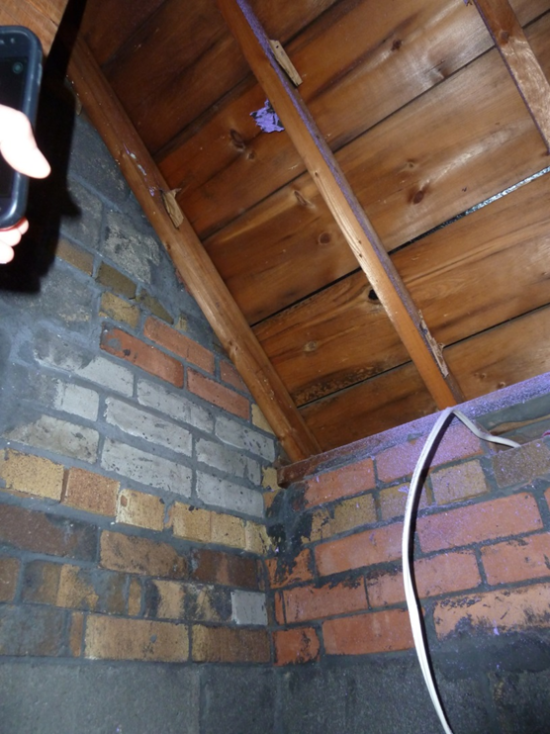
Wall to Rafters

In this East York 1.5 story, the roof rafters bear on the masonry and getting the air tight seal around the rafters at this junction is crucial for a DER.

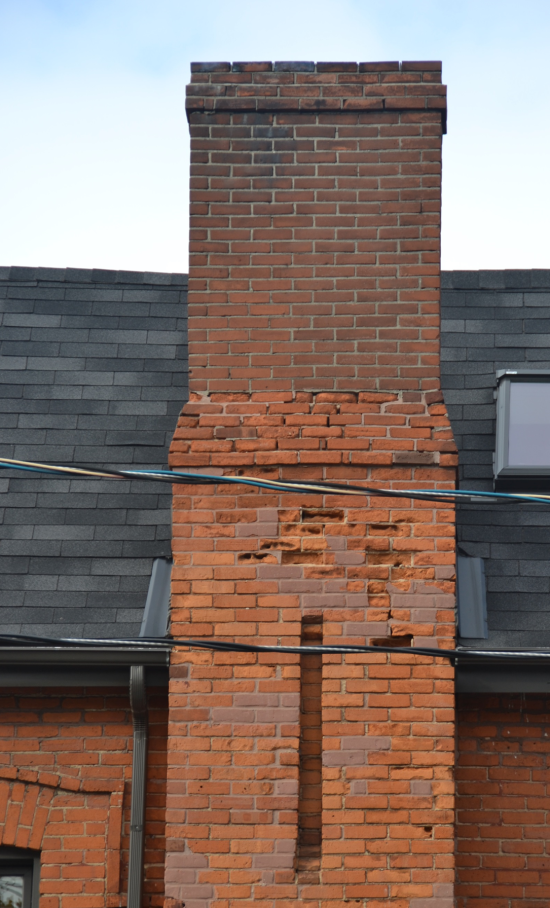
chimney

Though they add lots of character and reference a period in history, the chimney should be taken down and air sealed at the top floor ceiling height.

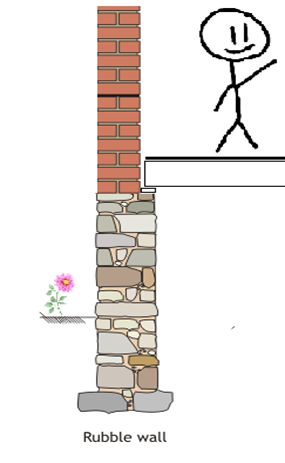
The advantages of exterior insulation are that its less disruptive to the occupants and allows the embedded floor joists to stay conditioned year-round. This last point is crucial and the risks especially to the main floor where the untreated wood mud sill is embedded into the masonry


Mudsill

Protecting the mud sill from potential rot in an interior retrofit is crucial for durability. See Dr. Lstiburek’s article on this issue.

Toronto homes have masonry going right up to the back side of the roof deck and the ceiling joists and roof rafters punctuate the air barrier depending on where its located for the ceiling. Using the exterior liquid applied air barrier on the face of the exterior brick wall, the continuity at the roof to wall junction might be detailed most successfully with the fewest penetrations if a hot roof is used and the detailing of these points would make for another BCS article!

Click on the link below to read the full article:


BSI079_Figure_05_web

Click on the diagram above to read the full blown article on deep energy retrofits of solid masonry homes.

Unpacking the 2014 Building Science Summer Camp

For the 6th year now, North America’s building science gurus Joseph Lstiburek  (U of T engineering grad) and Betsy Pettit hold an open house and generously welcome building scientist and efficiency practitioners into their home and hold an intimate tête-à-tête in the basement while sipping away on some fine reds. Again, this year Peter Troast brought back the transcript from the crypt and posted it on the Energy Circle Blog.

The short text is worth a read but we offer a contextualised take on Dr. Joe’s views like we did last year and it should start with the histrionics of the Passive House movement. With high utility costs and the scientific evidence pointing towards anthropogenic climate change,  Chernobyl‘s cloudy threats to the German people were the coup de grâce that triggered government funded research on conservation and efficiency. Funding in hand, the Germans promptly started by scooping all the great building science developed in North America following the 1973 Oil Crisis.

The Saskatchewan government funded technology that developed the Conservation House lay languishing once the crisis subsided and with continued low utility cost and the fact that NA is a resource resource rich continent, there was no incentive to develop efficiency or conservation as an energy strategy. So the Germans and Swedes picked up where we left off, refined the concepts and made it their own. To paraphrase Dr. Joe’s words, the Germans “built, pushed, broke and fixed” and now North America is poised to finally start catching up to the EU and arguably, will produce a more climatically responsive standard than the one size fits all approach developed by the Germans in the early 1990s.

It should be noted that Dr. Joe is working with PHIUS to develop a comprehensive, climate specific North American Passive House standard. So he’s close to the cause, which is a nice bout face from where he was in the late 2000s. The PH movement needs allies like Lstiburek and he needs the boundary pushing its dedicated adherents are doing to keep Building Science Corp focused and relevant on the housing side.

When asked “are we making progress” Dr. Joe optimistically responds “There is a backlash against complexity. The coming together of the architects and engineers is what will take us to the next level. The training of architects and engineers is leading to simplicity and elegance.” But the sad truth is that what’s being built is still complex in both residential and commercial sectors and if there is a backlash its miniscule, but growing as fast as those niche developers, small builders and architects can push.

In a blog posted last week, I wrote about the trend to build complicated new homes that resemble origami and high-rise residential is no better with nearly 100% glass façades and projecting balcony slabs that aren’t thermally broken. The same goes for mechanical systems – they are a technological zoos and homes with furnaceless rooms like the one’s Ed Marion builds are not as common as inferred. So yes, we agree that #BoxyButBeautiful should be trending, but the reality is that many architects are still designing structures that bleed energy through their complex structures and are generally over mechanised.

When asked where he sees innovation, he said “I continue to be amazed at passive house, and the fringe sustainability movement. I’m impressed at the technology. You can’t always model and calculate. You need to build, push, break and fix. I’m amazed at how much good stuff is coming from people who use this approach.”

He’s right about the amazing people around PH that are building, pushing, sharing experiences and breaking new ground which evolves into the next iteration of more refined buildings. It is very exciting, but sadly only a few builders and architects are pushing for high performance but is trending up. Building codes and ensuing municipalities still allow you to build a house that doesn’t perform optimally, isn’t tested and often poorly ventilated.

On energy modeling, to get valuable information, a professional needs to know the software’s limitations and be able to interpret results, and of course, as the old saying goes; garbage in garbage out. So we’re not sure where Dr. Joe was going with “You can’t always model and calculate.” But we suspect what he meant was that the final built product may not reflect the detailed intent of the energy model and in that regard, he’s right. Planning is given short shrift and yet, so many problems could be avoided by testing the building, by hiring qualified people and hiring a good architect that brings a team together though an Integrated Design Process. Detailed energy modeling is the best we have for optimising building enclosures so ditch the ASHRAE tables and use a computer.

When asked about his thoughts on mini­split heat pumps, he replied “I don’t like mini splits. They’re ugly and ineffective. They’re a passing fad.” We agree, they do take wall real estate but the highly effective ‘fad’ has been growing globally for the last 20 years  and is just starting to make headway in NA. They work, are very quiet, are brilliant for old houses and work in both heating and cooling seasons; a small aesthetic price to pay for convenience, performance and comfort.

Mini splits’ growing popularity with the high performance crowd is due to their vastly superior energy performance which can’t be matched by the traditional NA “cobbled in place systems”. Marc Rosenbaum argues that mini splits deliver performance ‘out of the box’ and points out that that traditional HVAC systems – according to Energy STAR in the US – require commissioning because they lag in performance so severely.

Lstiburek’s main point of contention with duct-less systems is that “At some point, you’re going to have to move air in ducts. It’s only a question of how big and where. You have to move air around your building for contaminant control. If you’re good you don’t need to move it for thermal control. But there are going to be ducts. There is going to be mixing.” and we agree that good ventilation design includes a fully ducted HRV!

The real insights Dr. Lstiburek’s given us these past few years are gems and he’s distilled the message down to “sucking is stupid, blowing is better, balance is best.” or “The principal water and air control should be on the outside.” The first is a powerful insight and bears contemplation, the latter just makes total sense.

Inclosing, its nice to hear the collaborative, conciliatory approach Dr. Joe’s taking and we can only hope that his message that “Simplicity and elegance are winning. We’re very close to having buildings so simple that everyone will know how they work.” comes true, but without a cohesive, national strategy on energy efficiency we’ll have to rely on the countless small builders and boutique architecture firms that push high performance to the next level with their sweat equity.

Strange Sighting on Wild Side of Queen West

****Warning: There’s no building science in this blog post!****

Always amazed at the wild things you find off Queen Street in Toronto, but today it was a bird; a big one!

IMG_20140814_141427226

Dead centre, the Heron is scoping out the alleyway behind our offices (Robertson Building at 215 Spadina Ave), dated August 14, 2014 2:15PM.

The Great Blue Heron is a majestic bird and typically reclusive so I was stunned to see it in an alley downtown when I was leaving the office. Graceful to see it overhead took me away from the madness for a few moments…

Pelicaniformes

A picture I took in August 2011 in Big Salmon Lake in Frontenac Provincial Park.

BGG Spot the Design Weakness – No.2

Steel has outstanding properties when it comes to strength and thermal conductivity. For buildings, we like steel’s strength but not it’s conductivity – great for frying pans – not building shells! When steel is placed in the same plane as the insulation it creates a very good thermal bridge, which is undesirable in efficient buildings.

Even though the OBC’s SB-12 tries to mitigate on the design stage by requiring more in/out board insulation as described in section 2.1.1.4, it seems most are unaware that it’s a significant liability to comfort, savings and formation of condensation if air leakage isn’t controlled. In fact, many consider steel and wood interchangeable when it comes to performance; NOT!

When detailed properly however, steel’s ability to wick comfort out of a building can be significantly reduced and yes, the OBC does a decent job at mitigating this undesirable weakness for new construction. Where people get into trouble is with big structural steel and during renovations in using steel framing to fur-out a solid masonry wall for insulation.

This video shows big structural steel and specifically the large end of a steel beam that’s holding up the brick wall above a garage door – 22 seconds in – and another big piece – 35 seconds in – holding up the floor joist load.

smallDSCN0463 (Custom)BGG

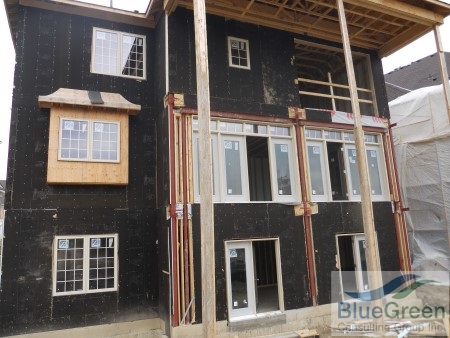
The red powder coated steel columns in this photo are installed in the wall assembly with the insulation and the OBC doesn’t seem to apply to larger columns when seeking to reduce thermal bridges.

In the following video pause 7 and again at 15 seconds to look at the powder coated steel. The first pause will show steel that eventually will touch the back of the drywall. The second pause shows an exposed floor where the HVAC ducts will run outside the house envelope and run along a piece of cold steel.

DSC_0511

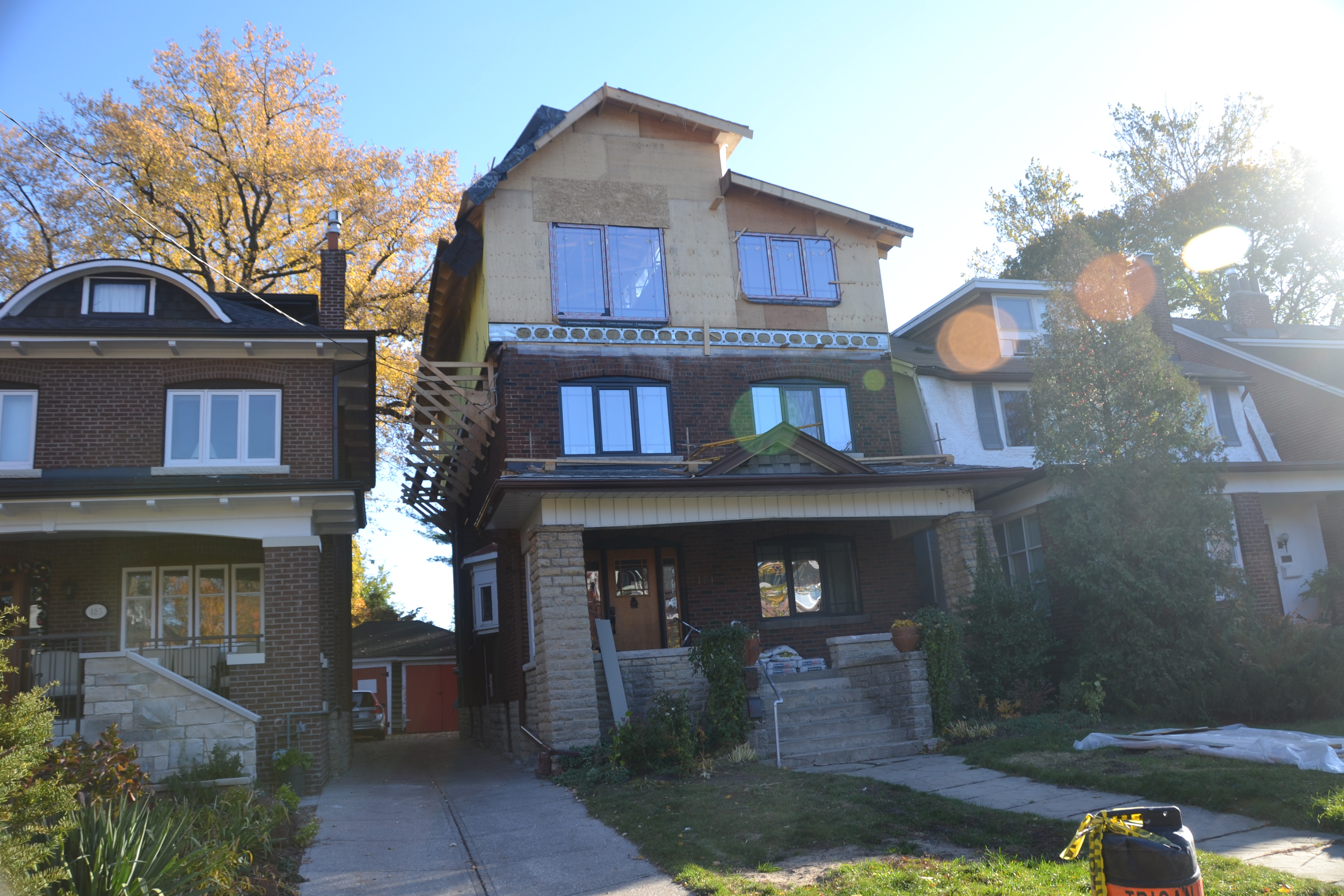
This 100 year old Toronto home gets a nice 3rd floor addition, but the small overhanging floor detail on driveway side is prone to air leakage and insulation detailing weakness, but so too is the choice of steel for the floor joists.

HP Addition

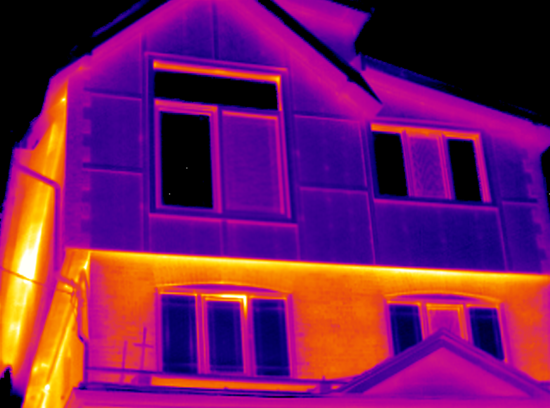
The floor cavity detailing is clearly compromised as seen in this IR photo of the above house. Thermal weakness is a likely combination of bridging and air ex-filtration.


Solares Architecture in the News… Again…

This young, dynamic firm is in the headlines again! Check out the latest in the G&M Globe and Mail Home and Garden.

Solares just keeps growing and producing consistent high performing results; doesn’t mater if its a new house or deep energy retrofit of an existing house.

I had the good fortune to not only test this house, but walk by it in my neighbourhood. For a Deep Energy Retrofit, this house adds to the street-scape and blends in seamlessly. A fresh look for another century of good living.