Archive by Author

Where Radiant In-Floor DOESN’T Belong

Radiant in-floor heat is growing in popularity and it should be noted, there are some places where the tubing shouldn’t be placed. See below!


Fridge under fire

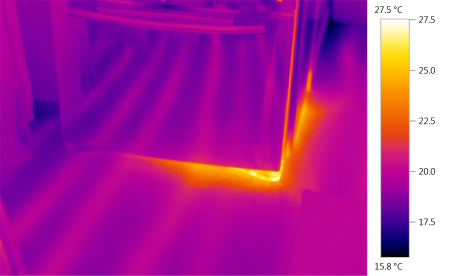
It’s quite common for refrigerators to dissipate their heat under and behind the fridge.

The image below shows two sources of heat; the fridge trying to move heat out the bottom and the lines in the floor (reflected by the shiny stainless steel) show the radiant in-floor tubing. The heating system was just getting going (10 mintues after firing the boiler) so the floor wasn’t up to design temperature yet. As the slab gets significantly warmer, these two sources of heat will fight each other and the fridge will lose by decreasing its ability to lose heat into the kitchen. Take note radiant people, don’t install radiant in-floor tubing under cabinets and especially not under refrigerators!

Hot Fridge

To keep the food cold, the compressor pumps the heat out of the food and into the kitchen. Specifically, it moves heat out under and behind the fridge. As seen above, the hot yellow heat signature in the floor’s concrete shows that the fridge needs to get rid of heat.


Keeping the Throne Hot

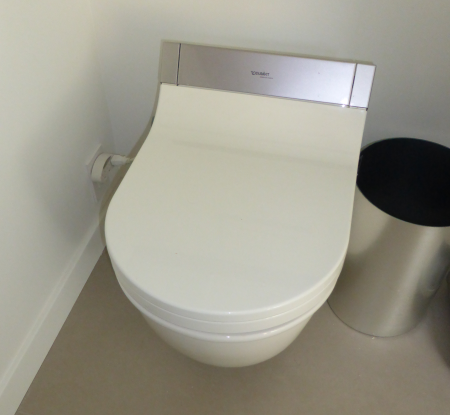
I’m told that traditionally, Japanese homes were not centrally heated and to cope with the cold, they use a number of strategies that include passive warming strategies like clothes and bedding (kakebuton) but also include active strategies like a heated bath (Ofuro) and the beloved communal seating area (kotatsu). But for anyone who’s had to use an outhouse mid-winter, the Japanese take throne comfort to a new level with electrically heated seats:

Craper

This plug-in, electrically heated toilet seat is deluxe!


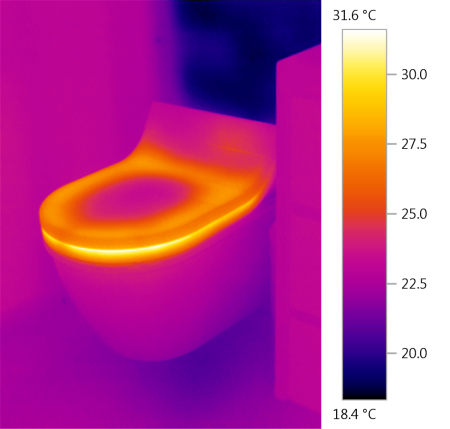
In the cultural context, this extravagance makes sense given that the temperature in Japanese homes is significantly lower than homes in North America, but import that toilet here in North America and it seems out of place:

Les fesses chaude

The infrared image above shows the electrical loss into the room from the toilet seat. I imagine the Sensowash is an experience is an experience to behold! Depending on the model, it washes and air dries – no need for shit-tickets!

LED Lights

IMG_20150329_091137318 (Custom)

I recently purchased a Nanoleaf Bloom light emitting diode (LED) ‘bulb’ at the home show. After a month of use, it’s performing flawlessly I’m pleased to say. Where earlier versions of LEDs had a harsh white and ‘shaky’ light that made for disagreeable book reading, this light goes on and off quickly with none of the jumpiness or delays often associated with compact fluorescent lights (CFL) or earlier versions of LEDs.

IMG_20150329_091215916 (Custom)

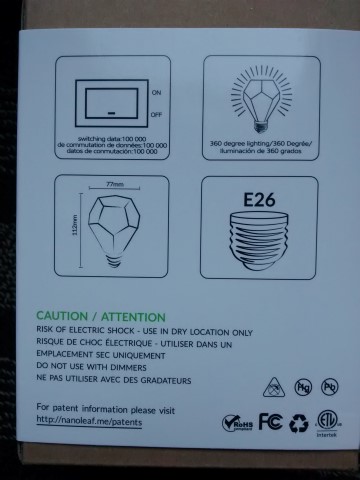
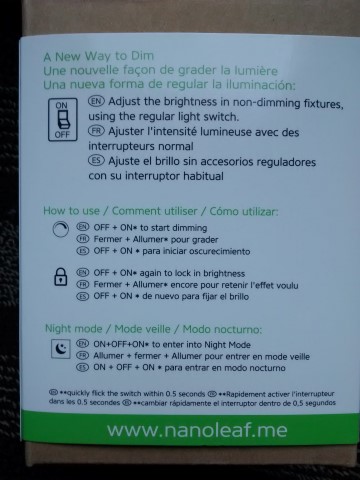
This brand in particular has a dimming feature that doesn’t need a dimmer control at the switch (see below). The feature can be activated by signaling with a “Morse code” on/off pattern at the switch when the desired level is reached. It also has a nigh light setting that can be activated with the regular light switch.

IMG_20150329_091209487 (Custom)


These bulbs also come in a “100w incandescent” light output equivalent, which is surprisingly hard to find if you need that extra bit of light for that dark or larger room.

I bought it from Mike Cerqua who is currently setting up an on-line store, but in the mean time, Mike is retailing them on either  ebay.ca or amazon.ca. Alternatively, you’re in the GTA, you may want to contact Mike directly, drop me a line and I’ll send you his contact information.

IMG_20150329_091155140 (Custom)

EU Pioneer Award for 1970s energy efficient house in Canada

Project manager Harold Orr was honored at International Passive House Conference

The Saskatchewan Conservation House

Darmstadt, Germany. This year’s Pioneer Award, which recognizes the trailblazers of energy efficient construction, will go to Canada. In particular, the Saskatchewan Conservation House will be recognized, with which many features of the modern Passive House Standard were successfully tested in 1977. Against the backdrop of the oil crisis at the time, a broad team of experts looked at possibilities to significantly reduce the consumption of heating oil. Their studies showed that it was mainly a question of thermal protection of the building envelope. Canadian mechanical engineer, Harold Orr, one of the driving forces behind this project, will receive the Pioneer Award at the International Passive House Conference 2015 in Leipzig.

The above paragraph was directly purloined from the International Passive House Association and the news is bitter sweet for Canadians. Sweet because so many excellent Canadians pioneered the core concept of Passive House and bitter because the growth in supper efficient housing is happening in every industrialised nation except Canada.

This bar graph shows exponential growth in the Certified Passive House builds in the USA. Get on it, or be run over by it… with the exception of Canada – we’re still at the 2007 marker.

The graph above only shows half the picture for projects certified by PHIUS which doesn’t include homes certified by PHI. Though take-up in Canada has been slow, industry insiders feel a surge in interest. The CBC* reported recently on a Smithers, BC house to be built and Passive Buildings Canada has been gaining membership and general public interest in the talks they regularly host. All this to say that Harold might just see the fruits of his early labours finally come back to Canada. There is hope and change is coming – starting perhaps with the election in Alberta today!


*Its a shame that CBC sandwiched the earthship article in the above link. Passive Homes are meticulously planned, energy modeled, built by professionals and rigorously tested to produce a known energy performance. This means Passive Houses are poised to go mainstream whereas earthships are cobbled together, typically not energy modeled, rarely tested and have a history of being plagued by many issues. As the story reads “Earthship life has its challenges — the couple endured their first winter with no source of heat other than the sun (they have since brought in a wood stove.)”

Are High R-value Wall Assemblies Risky for Ontario?

Building Science Corp’s recent study on humidity in walls in the North East was interesting, but it only looked at “…relatively vapor open Class III vapor retarder (latex paint on gypsum board) as the interior vapor control layer.” Unfortunately for Ontarians, the building code requires a vapour barrier in many cases, so the results of that study aren’t really applicable.

Adding insult to injury, Ontarians don’t really know what IECC climate zone they’re in. What we do know is that Ontario’s climate is both “cold” and “wet” which means high R-value wall assemblies have a lower drying potential in cold months, which can make them prone to condensation.


IECC climate zone map

IECC climate zone map doesn’t cross political boundaries…


Now the good news…

The Canadian Wood Council and  Chris Timusk of George Brown College have teamed up to assemble a data base of hundreds of wall assembly variations with WUFI analysis for each scenario. This is a brilliant resource for energy modelers as it gives a WUFI simulated durability analysis and the composite R-value of the wall assembly – a fantastic resource!

Below is but one sample of hundreds of variations:

Wall Asembly eg

Graham Finch on Moist Attics

Over the years, we’ve documented many attic failures due to issues of condensation and ice damming. We thought we had the market cornered on horror pictures until I came across Graham Finch‘s presentation (below) on ventilated attics.

If you have 25 minutes and a bowl of popcorn, this is a good presentation that covers the topic thoroughly.


Most Air Tight Home in Canada!?

We’re not sure, but we think we stumbled on the most air tight in Canada. Last year I threw down the gauntlet on LinkedIn suggesting we may have tested the most air tight house in Canada first in Saugeen Shores, then in Oakville Ontario. I put my money where my mouth was by betting a pint to anyone who bested our score.

My temerity was quickly rewarded with a rebuke from Shaun St-Amour in Vancouver of Footprint Sustainable Housing, followed by Gath Hood of Thoughtful Dwellings in Fredericton, who informed me his test trumped ours – resoundingly.

Gath was referring to a house he had the good fortune to 3rd party test, the Naugler House. This Fredericton home was designed and built by Tim Naugler of Southern Exposure Construction Inc. With an ELA of a mere 27.6cm2 and an ACH50 of 0.21 (average result of a de+pressurisation tests), it’s ELA beat our best by nearly 50 cm2. He had to use the ‘E’ ring! So jealous, I have one but its sitting in a glass case waiting to be called into action…

Anyhow, a big and hearty Congrats goes to Tim and the crew that assembled the home – you might consider offering your repair services to the Canadian Navy’s sub fleet.

Naugler House Prize (Custom)

Its not much of a reward, on an old x-mas card to boot, but we’re keeping our promise of buying a ‘pint’… of coffee. It’s not that the local Tim’s won’t redeem this gift certificate card because its branded with the Maple Leafs… but ‘er we hope you don’t get beat up in Fredericton.

Toronto’s Blarney Stone Nearly Gone


Queen and Spadina

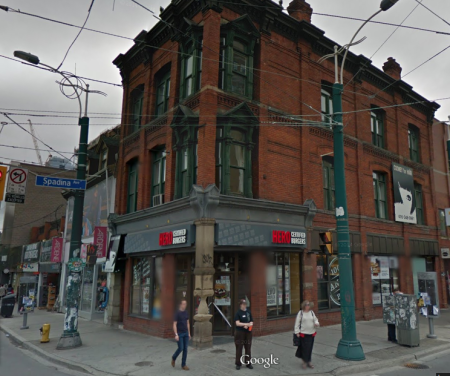
If you ever though you’d see the day when the sandstone column holding up this old building on the south east side of Queen St West and Spadina Ave needed replacing – the hour has come! Thanks Google Streetview!

I love Toronto’s old buildings and as I walk I pay close attention to them. For those of you who’ve not been around the Victorian era buildings of Toronto for a while, you might be interested to know that the original sandstone column at 441 Queen Street West is now on life support. Time to say good bye!

Sandstone

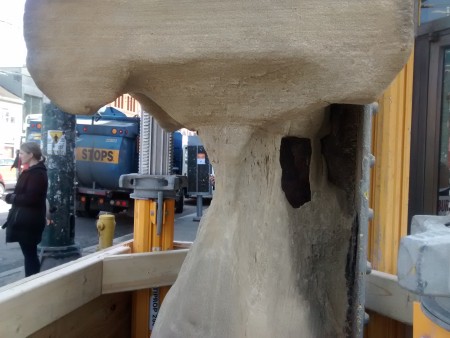
The column on life support, your chance to get one last rub of the weakest piece of sandstone in the city!

Over the years I’ve watched the column at this very busy pedestrian intersection erode and rightly so it has to go. Every time I passed, I imagined the building owner was holding on the the past to keep it there as long as possible and was glad someone had the notion to allow us to witness this slow crumbling over so many years. It took on a bit a bit of a mythical status for me – kind of like Toronto’s Blarney Stone I imagined. Though I never touched it for fear of precipitating collapse, I always wondered if it had any magic in it! I mean somebody was rubbing this thing like a goat with a serious itch while no one was looking!

IMG_20150410_121303271

With maybe only 25 square inches of weak sandstone holding up the stone above, it will go soon. I wonder what they’ll put in it’s place… Maybe I should give it a rub to see if there’s some magic in it!

PH Above the Crease in NY Times!

Sadly, you won’t find it in Canadian newspapers. Nope you have to go south of the border to read news about the building method that’s taking off south of the 49th and the New York Times’ Alison Gregor nails it in her article last month about Passive House in New York. NYPH covers what the Real Estate section article got right, including the fact that vintage buildings are being successfully retrofitted to the standard. Even without and Environment section the paper, the NY Times still plugs passive house in the Home & Garden Section with this fresh article on Passive Homes. Clearly the Editor sees a trend in NY that Canadian news papers don’t see in Canada.

As much as we’d like to blame the Toronto Star, or the Globe and Mail for not covering Passive House and for continuously pushing the status-quo on ‘green’, it might have something to do with the fact that Canadians have lower energy costs and live in a country that currently sees itself as a resource-based economy and consequently, some Canadians aren’t building high performance homes as few homes in the GTA meet the Passive House Standard.

There are bright spots though. Places where high performance homes are being built tend to be places where no access to natural gas for heating exists and the hot bed in Canada is Nova Scotia, where regular home owners want good affordable built houses that don’t cost an arm and a leg to condition the living space. Natalie Leonard of Passive House E-Design has built the most Passive Homes in the country and she keeps churning them out like hot cakes.

Why TO Should Love Passive House

475 High Performance Building Supply tells it all in this short video where Floris Keverling Buisman gives a brief example of the amazing sound damping abilities of a home that is airtight and highly insulated. This is a historic masonry home in Park Slope, Brooklyn that has retrofitted to Passive House level of quality. Are there any historic brick buildings in Toronto that could benefit from the same?

Why New Yorkers Love Passive House from 475 HPBS on Vimeo.