Blog

Can’t Flush with Crappy Design and Excecution

The winter vortex has been good for the diagnostic business and the work is always interesting. We’ve been doing a lot of dynamic testing using the infrared camera along with the blower door to non-destructively test and pin point envelope failures. I recently had the chance to check out a house in Maple where the water line to the 2nd floor master bedroom’s en-suite toilet would freeze when the weather was cold enough.

P1050862

The back side of a housing development in Maple Ontario showing the 2nd floor bath bump out.

P1050861

This cutesy bump-out sure looked nice, but it was causing some issues. Let’s look inside to see what was inside the the bump-out…

P1050871

The bath tub straddled the main floor wall ensconced in this back bump out. Note the electric heater was plugged into a GFCI. The toilet bottom left had frozen pipes when the temperature outside dipped.

Frozen Pipes

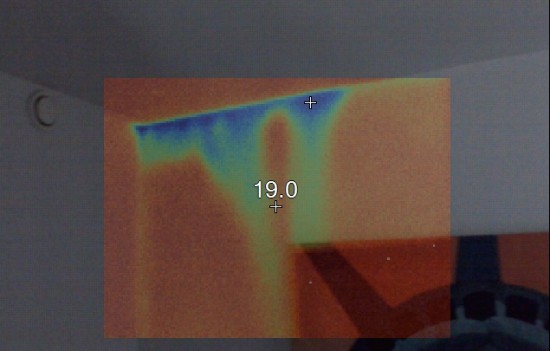
The image on the left was taken in the morning on the north face of the house, the one on the right was taken after 15 minutes of pressurisation with a blower door. The air leakage through the cantilevered floor cavity at the double trimmer joists on either side was significant enough to produce a significant increase in outside temperature.


On the whole, it appears the easiest solution would be to drop the exterior soffit and seal the floor cavity in the plane of the main floor wall below it, then insulate and replace the soffit.

Comments Off

Where High [Performance] Design Meets Boots on The Ground


Amazing evening! We asked the best high performance home architects, builders and renovators in and around Toronto to join us for a small networking session and it was a great start, sans fromage! Yes, I forgot the olives and cheeses at home, but that didn’t stop the networking from happening. The breadth and depth of experience in the room was inspiring for us and we thank everyone who made it.

Shervin and I have always felt that there was a disconnect between builders and architects in that they have different aims and they approach projects differently. Through his work doing Integrated Design Process approach with some of the awesome clients we have, it became apparent to Shervin just how beneficial pre-construction meetings with the architect, builder and sometimes the homeowner was to the quality and flow of the build. It got us thinking “Wouldn’t it be great to get the best Toronto has to offer in one room sharing best practices?” Thus the title of the event “Where High [Performance] Design meets Boots on the Ground“. We believe that professional design is key to evolving better than code builds, but it needs the care of a good builder too to make it happen.

From my years of working in and around Toronto one gets to know who’s really in the game when it comes to high performance homes and last night the lion’s share of practitioners were jammed into a badly ventilated room getting to know each other.  Sure there were varying degrees of purist there, but what we all shared was an interest in building better than code buildings – and BlueGreen Group wants to be there to help the veterans and the novice alike! We’re the cross pollinators that help spread best practices more effectively while bringing measured performance to each build or deep energy renovation.

There was consensus that in the face of climate change, building more durably and providing energy independence is vital to the future of homes. Of course the reality is that families are getting smaller and the homes are trending toward bigger; a design conundrum that perhaps better professional design can redress as suggested by architects like Sarah Susanka in the Not So Big House. Martin Leifhebber tackled the small house issue with one of his clients and the homeowner couldn’t be happier. From farming food in the house (herbs in the house and tilapia in the sump pit!), to wood foundations, advanced framing, to straw bale, rammed earth, timber framing, double stud framing, grey water reuse all the way to Fogo Island and the awesome work of Mario Kani – I think we struck a nerve and it was evident that people there wanted significantly better than code now!

Alas, the ice was broken and now the real work begins. We plan to roll out a second session this fall squarely focused on the experts sharing their best practices with others who want to push efficiency, increase sustainability and deliver timeless beauty for the house of tomorrow. So over the summer, take pictures of your projects and write up a presentation, we want to hear form you and so do others!

Let this be a call-out to you: we need presenters!

If you want to join, write us!

Martin Leifhebber

Martin Liefhebber (Breath Architects) talking about small super efficient homes, Roger Algie (Just Homes) fighting for efficiency in Toronto for 30 years and Craig Mahood (Mahood Contracting).

DSC_0141

Award winning architect Frances Martin-DiGiuseppe (Q4 Architects) and German engineer Shervin Akhavi.

DSC_0140

Sustainability and IAQ expert Bettina Hoar (Sage Idea Studio), natural builder Glen Byrom (Fourth Pig), Passive House designer/builder and egineer Lyndon Than (Passive House One) and Passive House trained architect Wendy Wishburn (superkul).

DSC_0139

Designer with huge knowledge base on Toronto homes Filip Simpson (TABC) talks with veteran engineer Mario Kani (Sustainable Edge) who can answer all manner of technical questions about super efficiency homes than any one we know.

DSC_0138

Christopher Philips (Greening Homes) delivering on sustainability during construction, Patrick Anders a Passive House consultant and Andrew Stiffman (SustainableTO) a building scientist.

DSC_0137

Engineering guru David Shephard (Monica Kuhn) and Paul Caverly (My Haven Homes) the Deep Energy Retrofit specialist.

DSC_0135

Ken George (All Angles Renovations) doing Deep Energy Retrofits and Amanda Levey (Sage Idea Studio) bringing fresh ideas to old homes in the city’s core.

DSC_0134

Anything you can dream made of solid wood Michael Krans (Timmerman Timberworks) can deliver – a pleasure to watch his crews make and assemble timbers and and Chris Johnson (Pro ICF) the guru of ICF.

DSC_0131

Christine Lolley (Solares) talking with the hardworking and super fun gents from Hardcore Renos; Anderson Hinds and Manny Neives.

DSC_0093

Paul Dowsett of Sustainable TO introducing his multidisciplinary firm.

DSC_0069

Christine Lolley of Solares Architecture talking about the proven performance of their homes; a young firm to watch.



Comments Off

Choose Your Poison – The Dangers of Attic Work


Going into attics can be an occupational hazard and it helps to know what some of the dangers are going in. Aside from the structural aspects and potential or placing a foot through a ceiling or crushing a duct, it always pays to be protected. P100 pancake filters on a silicone half face is my preferred breathing protection and clothes that can be taken of after attic inspection to be bagged helps.

I had the pleasure of auditing a 100+ year old house a few weeks back and prior to going up was happy to hear the client had the vermiculite tested for chrysotile asbestos. Results were negative so I went up and discovered something I have never seen in the hundreds of attics I’ve been in:

P1050854

Standing on the attic floor (see attic hatch upper left) I found this large, deep dark pile of what appeared to be mouse droppings on a deep bed of vermiculite. I’d never seen such a large pile.


P1050855

Closeup: Two possibly deadly dangers; both invisible. On closer inspection the dark pile sure enough looked like mouse droppings.. but so much in one place? The vermiculite got the green light through testing.

I didn’t make the connection until I found a dead bat on the attic floor. Being related to mice their poop was bound to look a bi similar. Though exaggerated, there is a fungus that can be in the bat guano that causes Histoplasmosis or “Cavers Disease.

So when your up there, practice good PPE, protect the air your breath every time!

Comments Off

BGG Hosts Contractor Training for SIGA Technical Tapes

BlueGreen Group hosted the latest contractor training session on the myriad uses of SIGA’s technical tapes and sealants. The course trainer was Romain Thomas, who took the class of 10 builders and consultants. SIGA spared no expense in developing great hand’s-on training mock-ups for the students to work on and actually try their hand at applying the tapes.

Mr. Thomas, himself a commercial building supervisor in Switzerland, took the class through the paces. Of the builders present, it was no surprise to see the best in the sustainable business with Christopher Philips, Eliot Callahan and Steven Gray of Greening Homes and Glen Byrom and Peter Shepherd of Fourth Pig.


DSC_0029

Steven Grey of Greening Homes took a 6″ peice of SIGA WigLuv and gave it a little tug and managed to stretch it 20″. Its flexible and is harder to pull off than tatoos.

In the December issue of Fine Home Building, Martin Holladay (you have to pay for it, so I’ll reference you to this Matt Risinger article instead) did a great piece on technical tapes and SIGA’s WigLUV consistently rated as a top product – at a top price. With their holster dispenser (comes free with a box of tape I heard) the tape looks and feels like a quality product.

We also tried Rissan 60, which is used indoors around penetrations like pipes and wires, though not stretchy in length, it does stretch in width to accommodate seasonal anticipated pipe movement. I could see this product being incredibly useful and more durable than the beloved red TuckTape. Mr. Thomas also brought out the pre-folded Fentrim which could be used if windows are placed mid way in the buck’s rough opening.

My favourite product was kept for last, Primur Roll which replaced a filet of caulking and this very sticky adhesive can be applied to clean concrete. It’ll stick to anything it seems and the suggested place to use it was for the joint at the weather/air barrier as it drapes the foundation wall on the outside.


Comments Off

Solid Masonry Research on Vintage Homes’ Update

How friendly are neighbours who share a common double brick wall? We teamed up with Ryerson University, Humber College and Project Neutral to do scientific research on a topic important to vintage brick homes. If neighbours are friendly, would they invite us in to accomplish our mission…. to evaluate the air tightness of their common walls?

It turns out, yes, they would! Since last September, 12 pairs of semi-detached homes have participated in our air tightness research program focusing on semi-detached homes. The homes were located south of Toronto’s St. Clair Avenue in the ‘M’ postal code area.


 Sealing up exterior walls is a no-brainer. But when it comes to Deep Energy Retrofits (DER) of semi-detached houses, is it important to seal up common walls too? We’re determined to find out!

We’re still offering qualified homeowners a free specialised air tightness tests that measure both exterior and common wall air leakge, and we still need 5 more pairs of semis! Participants receive a technical report that identifies main areas of air leakage.

As the Industry Partner, BlueGreen Group brought together Humber College and The Sustainable Buildings Group at Ryerson University. The students of the Sustainable Energy and Building Technology (SEBT) at Humber College gathered and analysed data on homes to identify best practices when performing DER on these types of houses. Professor Russell Richman from the Department of Architectural Science and Graduate Program in Building Science at Ryerson University oversaw the project.

The results will be published in a peer reviewed journal, which we look forward to sharing on our website likely by the winter of 2014.


Comments Off

Will the SB-12 Tsunami Strike Again in 2017?

In the early days of January 2012, Shervin and I watched the tsunami of Ontario Building Codes SB-12 changes wash over and bury plans examiners, window suppliers, designers and builders with the simple deletion of the word “voluntary” in front of “EnerGuide80″. By the summer of 2012, things were settling down but over the years, we still see so many custom and tract builders still opting for the black and white of a “package” in SB-12. Even more mind boggling was the fact that architects would limit themselves to no more than 22% glazing to avoid going down the “performance path.” What are they scared of?

We stuck it out and had a handful of architects who were brazenly unafraid of challenging their builds to a blower door test. Meanwhile, we were air tightness testing hundreds of new, tract built homes for ENERGY Star, giving us grist for the mill. As the years past a few renovators and builders started to glom onto our services as they see the value in ensuring their builds offer homeowners a tested product. That’s different! We all know that unlike cars, homes are not made in ISO9000 factories – they’re made outside in rain, snow, scorching sun with crews changing, building material delays and things happen. Quality like time can slip away on any build and having a 3rd party test the building shell before the drywall goes up often catches some major glitches that might have ended in discomfort or worse an ice damn, mould or condensation.

Truth is we can’t believe how much flexibility the EnerGuide80 path offers. It avoids the straight-jacked approach of SB-12 and gives the designer greater latitude especially where glazing is concerned plus they get the product that carries their name tested!

As we approach the halfway point in the 5 year code cycle, we’re wondering if 2017 will bring the same level of upheaval as 2012. Will architects and builders embrace the 15% jump in energy performance in the next code iteration? Our guess is that unlike the avant-garde professionals we work with, most will opt for a package and be run over roughshod by what’s already foretold in the code now. They will rush to approve as many permits by December 31 2016 while the architects and builders we work with will be future-proofing their homes towards Netzero or Passive House standard.

Comments Off

Are you Freezing Along With Your HRV Core?

In this post Dave Baerg asks “How many malfunctioning HRV defrost systems are out there?”

I met Dave in the summer of 1999 when we worked together at the Urban Environment Centre. Dave took me under his wing and got me interested in building science. Always passionate about his work, Dave explained things well and said “the best place to start air sealing a house is in the attic.” And though he moved to New Liskeard shortly afterwards, those words kept me interested solving condensation and ice-damning problems in some of the worst attics Toronto had to offer.

Ever the teacher, Dave sent me an email recently where he mused about how many HRV cores in northerly climes had their cores frozen with the recent drop in temperature coinciding with the recent Polar Vortex.

Let this be a lesson to those of you with HRVs; if you feel really cold air coming in through your ventilation supply registers, it might be a good idea to open up HRV and have a look under the hood!

HVAC and building envelope consultant Dave Baerg of New Liskeard explains how to identify a frozen core on an HRV. Note the white frost on the "tempered" fresh supply air coming out of the HRV. That's a lot of cold air being distributed throughout the house!

HVAC and building envelope consultant Dave Baerg of New Liskeard explains how to identify a frozen core on an HRV. Note the white frost on the “tempered” fresh supply air coming out of the HRV. That’s a lot of cold air being distributed throughout the house!

Dave said about the above picture “As you’ll see, the fresh air duct is covered with frost.  I first noticed a problem last winter.  When it was -30C or colder, I would come downstairs in the morning and it would be about 18C on the main floor.  At first I thought the radiant floor wasn’t able to put out enough heat to meet the main floor heat load.  Then I noticed how cold the fresh air was.  So, I put a thermometer into a supply register and got a reading in the low minus teens.  Then I checked the HRV. The core was frozen solid.  So, there was no exhaust flow to warm up the incoming supply.  In short, the defrost mechanism wasn’t working.  At -28C, it worked, at -30C we had trouble.  I finally got my installer out this week to change the sensor.  So far so good – we had a low of -31C the other night and it didn’t freeze up.”


Dave went on to say “What disturbs me about this is that I found it because I’m pretty aware of how my house works and, most importantly, my system is direct ducted; so, the supply air was very noticeably cold.  Would the average homeowner with forced air – where the fresh air supply is mixed with return air at about a 1:10 ratio – have noticed the problem?  How many malfunctioning defrost systems are out there?

So if you own an HRV and the temperature dips, it might be a good time to just have a peak inside or put your hand on the fresh air supply duct to confirm the temperature is significantly higher than outside air!

Comments Off

Old Mineral Wool – The Work of the Devil?

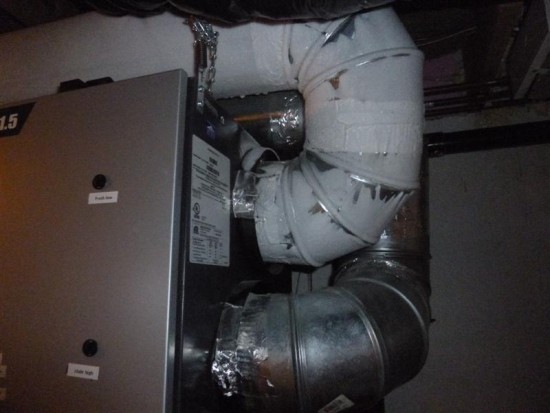
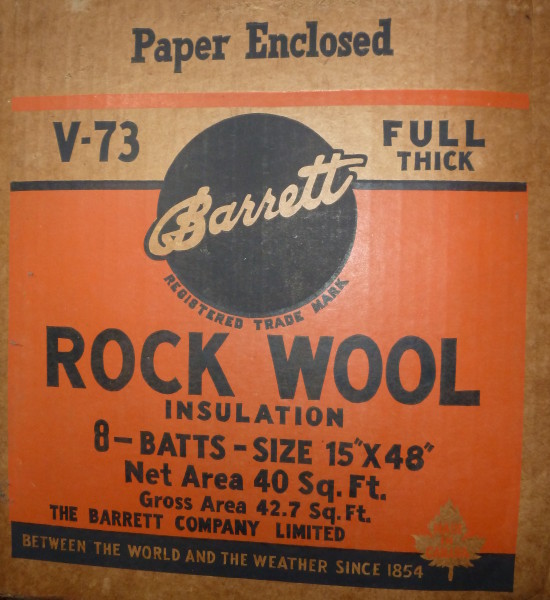
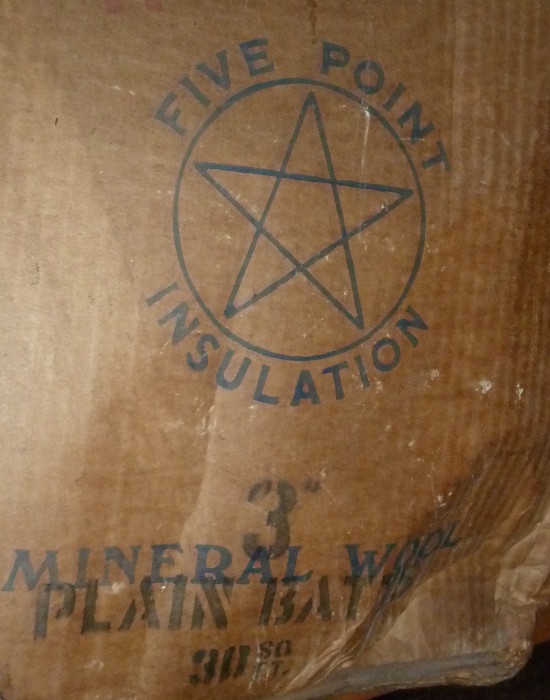
Anyone who’s had to work in an attic with old mineral wool insulation has felt the enduring, burning itch for days afterwards.  Likely, you’ve suspected this diabolical insulation was the work of the devil but never had any proof.

P1050583


Well, it turns out you’re right! Mineral wool is the work of the Devil, and we now have proof.

P1050580

BlueGreen Group has uncovered evidence in a dark Etobicoke Ontario attic that Mineral Wool Insulation IS THE WORK OF THE DEVIL, if not manufactured by devils. Not only is it itchy, but it’s heavy and only covers 30 square feet!


Mephistopheles – likely the inventor of Mineral wool – once wrote:

I must confess, my stepping o’er
Thy [attic] threshold a slight hindrance doth impede;
The wizard-foot [mineral wool] doth me retain.


It all makes sense now! What better way to end the year than by burning all your attic clothes encrusted with the infernal fiber? As an antidote, we highly recommend wearing P100 breathing masks and a string of garlic to ward off the effects!


Comments Off

Stop Spray Foam Bashing!

We like spray foam. Though I’ve been harping in recent posts like Pot lights and GBA that it needs to be air tightness tested with a blower door for air leaks – especially in Deep Energy Retrofits  – the product is only as good as the installation. For a good installation you need an experienced qualified installer pulling the trigger.

What’s a Proper Installation Look like?

There are a couple of important distinctions to make when talking about spray foams. Firstly, spray foam is “manufactured in situ” by precisely mixing two thick liquids, an isocyanate with a polyol at a high pressure and temperature. In other words, the liquid in barrels schlepped by the foam guys’ truck isn’t called “foam” until it’s sprayed in place. The second point is that for residential use, the most common types of foam used are medium density, referring to foam with a rigid, closed cell structure and low density or open cell foam which has a cell structure that is open.

P1050587

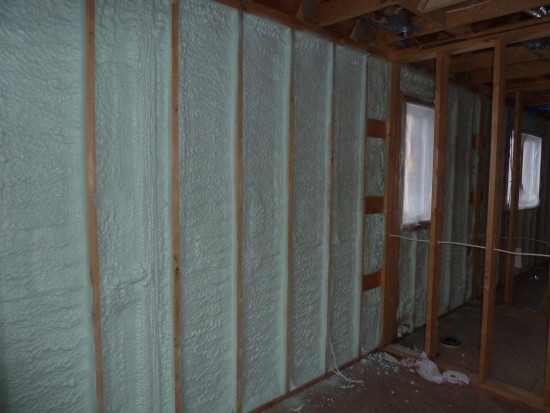
Not all sprayers are equal. In this photo, the HEATLOC SOYA was very evenly applied by an experienced sprayer. Note these stud cavities were in a bedroom with few obstacles that make foam a challenge; blocking, wires, plumbing etc.

Cell structure refers to the tiny bubbles that make up foam. Medium density spray foam has closed cells that trap gas in their cells. Closed cells have a higher R-value per inch and are more rigid that the open cell foams which are squishy and generally have half the R-value per inch than closed cell. Further, each spray foam brand has a slight variation in additives (usually colour)  in one or both liquid components. Each brand (I.e.Icynene’s MD-C-200, BASF’s WalltiteECO or Demilec’s Heatlok SOYA)  has to be tested by Canadian Construction Materials Centre to ensure the material meets CAN/ULC-S705.1-01.

The Ontario Building Code requires that manufactured medium density spray foam meets CAN/ULC-S705.1-01[i] which makes recommendations as to where the foam may be applied and how it’s to be tested and that the spray foam be installed according to manufacturer’s instructions and CAN/ULC-S705.2-05[ii]. CAN/ULC-S705.2-05 sets out the obligations of the manufacturer or supplier, the contractor and the installer. Don’t get me started on the fact that very few contractors have actually invested in buying the expensive sets of ULC standards and most installers have likely never read much less seen a copy of the standard.

There are a variety of tests that can be done on site and a good spray foam contractor will test their foam properties consistently. The physical properties of spray foam should be field tested at least once for every job site, every change in raw material LOT number and every day at the job site. Tests include:

  1. Adhesion to substrate
  2. Density
  3. Compressive strength
  4. Cell uniformity

The determining factors that go into a quality installation are twofold; the installer knowing enough building science to know where to spray the foam and finally to have a 3rd party firm air tightness test foam BEFORE the drywall goes on. Because medium density foam typically doesn’t fill the stud cavity completely, the air gap behind the drywall connects holes and voila, all you need is a bit of pressure on either side of the hole to drive conditioned air out. Just one hole in the spray foam can cause air leakage to negate the good intentions of the spray foam, but more typically, there are more than just a hole in the spray foam – did you see our pot light video- for retrofit foam jobs that don’t have an air barrier and depend on the spray foam to be the air barrier.

Bath air leakage TW 2013

This infrared picture in visible picture of a bathroom wall detail shows air leakage behind the drywall. The blue denotes a plume of cool air washing the back of the drywall. Sadly, a blower door test could have probably identified the air leak which could have been repaired BEFORE the drywall went on.


[i] Standard for Thermal Insulation – Spray Applied Rigid Polyurethane Foam, Medium Density – Material – Specification.

[ii] Standard for Thermal Insulation – Spray Applied Rigid Polyurethane Foam, Medium Density – Application


Comments Off

The Mighty Blower Door

Some friends were vising from the US recently and Jack  suggested I check out a blog called  Do The Math. In the blog, Astrophysisits Tom Murphy shares his views on “societal issues relating to energy production, climate change, and economic growth. [His] approach is often playfully quantitative, with the aim of arriving at a fresh perspective on our world.

I’m not sure if Jack knew there was a nugget in there for me, but sure enough, a fairly technical blog post was written up about the air leakage properties in buildings, and demonstrated techniques of using a blower door for apportioning leaks throughout the house! I was stunned as Dr. Murphy delves into some meaty stuff for building scientist in this post titled Let’s Blow this Joint. Once you get past his use of the word ventilation (we building scientist know ventilation means mechanical ventilation – blow/suck/balanced), which he equates with natural air infiltration, it’s a must read for any building scientist.

In a nut shell, this is what I got from it:

  1. In the blog, he gives a great link to a Lawrence Berkley Lab document that helps you convert an Air Change per Hour at 50 Pascals (ACH50) of depressurisation to Air Change per Hour Natural (ACHNat) or at standard atmospheric pressure.
  2. He delves into the fact that air leakage isn’t linear with pressure be it induced by stack or wind effect. Though counter intuitive air leakage is more accelerated at low pressure differences than at high. Translation; it doesn’t take much pressure to move lots of air so even. “The littler gaps matter” as he says of his window experiment.
  3. Room by Room: I had read about doing room by room testing in Home Energy magazine, but Dr. Murphy takes it one step further and makes me think I need the DG700 WiFi attachment so I can walk around the house closing doors get get my data without having to go back to the fan! I love the fact that he even managed to break down and attribute the air leakage to specific item like a pot light.
  4. Conductance: I’ve never heard of dividing the Cubic Feet per Minute (CFM) by the pressure (Pascals) in this case at 50 Pa. I think this way of normalizing the data might be very useful for comparing leakage from one room to another.

Overall, it was a fresh read and I really appreciated his explanations plus he reminded me of the power of a blower-door as a diagnostic tool when used by the right people!

Comments Off