Archive | Blog RSS feed for this section

Toronto Community Housing – Something to Aspire to?

POTUS has announced a plan to bring energy efficiency to US households. Among the initiatives announced is the establishment of a Passive House track by New York State Homes and Community Renewal (HCR) that seeks to “to encourage a significant increase in the energy efficiency of New York’s affordable housing stock.”  The White House press release goes on to say:

“HCR intends to work closely with NYSERDA to monitor the ongoing energy use intensity of any Passive House projects that may be selected for funding under the RFP, in order to provide valuable data to the market to accelerate the trend toward construction of Passive House certified affordable multifamily buildings.

With the possibility of Harperman looking for a new gig this fall, perhaps some fresh national leadership on this file is in order and Toronto’s Community Housing should take a page out of the POTUS playbook.

Holly CanCon Batman! Are you Going?

Next week, PHIUS’ North American Pasive House Conference takes place in Chicago and the line up of speakers is impressive – though really, many of these industry leaders also attend our Boots on the Ground event. What’s more impressive is the level of CanCon at the conference, check them out:

Mike Anderson

mike anderson

Passive House E-Design

Mike Anderson has helped create some of the most high-performance buildings in Atlantic Canada. Since graduating with a Masters in Architecture in 2012, Mike has designed, built or consulted on many Passive House projects, at scales ranging from small cabins to large apartment buildings. Drawing from his backgrounds in physics, construction and architecture, he brings a dedication to making environmentally responsible and beautiful spaces accessible to people who aren’t necessarily millionaires.

SYLVIA COOK

sylvia cook

Aerecura

Sylvia Cook BSc, MSc, BEd., for many years a secondary school Science teacher, lived in a small Ontario town overtaken by stick-frame suburban sprawl. For her this phenomenon epitomized the inefficiency of climate injustice, an issue she sees as the most pressing of our time. She had long enjoyed researching building alternatives, and when she came upon rammed earth, she realized it met all of the criteria she had come to associate with sustainability. Rammed earth is a most efficient use of energy and resources and healthy on so many levels for people and the planet. Her belief in ?thinking globally and acting locally? in improving the built environment has led Sylvia into launching a second career establishing *Aerecura Rammed Earth Builders*, a company that creates beautiful, comfortable, affordable, healthy, environmentally sustainable, rammed earth buildings.

elliott, ross

ross elliott

Homesol Building Solutions, Inc

After two decades building and renovating super-energy-efficient, earth-friendly homes, including some of Canada’s first R-2000 houses, Ross founded Homesol Building Solutions in 1999 to deliver energy design and green building consulting services. His addiction to low-energy construction can be traced back to Shelter Institute and Cornerstones in Maine, where he was licensed as an Energy Auditor in 1983. Ross is a Certified Passive House Consultant (Germany & US), LEED-AP (Building Design & Construction), Licensed Carpenter, PHIUS+ Rater, PHIUS Certified Builder and a Certified Energy Advisor for ENERGY STAR and R-2000. His qualifications include Air Systems and Radiant Hydronic Design Technician, and an Ontario BCIN Designer designation. Ross is a founding member of Passive Buildings Canada and CRESNET, and a director of the Ontario Natural Building Coalition. He was the recipient of EnerQuality Evaluator of the Year in 2007 and 2011, and the Hall of Fame award in 2014 for making a lasting impact on energy efficiency and green building. He lives in a low-carbon owner-built LEED Gold / R-2000 home with a strawbale studio and a soap-bubble insulated organic greenhouse, in the heart of a maple sugarbush near McDonalds Corners, Ontario.

Steven Gray

steven gray

Greening Homes Ltd

Steven P.Eng., CPHC, LEED AP Initially trained as a structural engineer, Steven went on to earn a masters degree in building science and is a Certified Passive House Consultant. He has a passion for building and constructs energy-efficient projects with Greening Homes in the Toronto area. Steven has presented as a guest lecturer in upper-year and post-graduate building science courses at the University of Toronto and Ryerson University.

lstiburek

joe lstiburek

Building Science Corporation

Joseph Lstiburek, B.A.Sc., M.Eng., Ph.D., P.Eng., is a principal of Building Science Corporation and an ASHRAE Fellow. He is also an Adjunct Professor of Building Science at the University of Toronto. He is a building scientist who investigates building failures.

Dr. Lstiburek received an undergraduate degree in Mechanical Engineering from the University of Toronto, a masters degree in Civil Engineering from the University of Toronto and a doctorate in Building Science Engineering from the University of Toronto. He has been a licensed Professional Engineer since 1982.

When he is not in buildings he drinks red French wine and drives fast German sports cars – but never at the same time.

magneron

stephen magneron

Homesol Building Solutions

Stephen is a Certified Passive House Consultant, PHIUS Certified Builder and Certified Energy Advisor / Green rater for ENERGY STAR, R-2000 and LEED for Homes. He has been working as an Advanced Housing Specialist for Homesol Building Solutions since 2010, collaborating with builders, designers and homeowners to create more energy efficient, sustainable, and affordable human shelter. A valedictorian graduate of Algonquin College’s Construction Carpentry – Advanced Housing program, with hands-on construction experience with an award-winning green renovator, Stephen is proficient with PHPP, WUFI and THERM. He is evolving next-generation Zero Energy+ homes, and was the lead researcher comparing Passive House with EQuilibrium Net-Zero Energy and SuperEE homes for Canada Mortgage and Housing Corp. (CMHC). He’s a permaculturalist, fire-spinner, father of two girls, expat Australian and lives east of Ottawa, Ontario.

matthew tokarik

matthew tokarik

Ryerson University, EIT, MASc, CPHC

Matthew is a building energy consultant specializing in the creation and calibration of whole building energy models. He has been a PHIUS Certified Passive House Consultant since 2013, and his professional experience involves residential mechanical design, and commercial energy modeling. Earlier this year, Matthew received a Master’s degree in Building Science from Ryerson University, where his research focused on life cycle cost assessment of passive energy conservation measures. While at Ryerson, he led the performance optimization and mechanical design efforts for Team Urban Harvest in the 2014 US DOE Race to Zero competition, where the team won awards for Grand Winner, Best Design Solution Integration, Best Technical Integration, and Best Presentation.

terrell wong

terell wong

Stones Throw Design

Terrell Wong is an architect with over 25 years experience. Her passion for the environment and design has greatly influenced her career. In 2006, Terrell lead the winning team to the National Archetype Sustainable House Award. Their “Building Blocks” modular home concept was constructed at the Toronto and Region Conservation Authority’s Kortright Centre as a showcase for sustainable design.

In 2009, Terrell was a founding member and President of Passive Buildings Canada, a national membership-based, non-profit organization that promotes the Passive House concept.

Terrell’s firm, Stone’s Throw Design Inc., specializes in low energy residential design. With its focus on building science, the firm creates designs utilizing cutting edge materials and techniques. In 2011, they completed the first insulated rammed earth house in Ontario. This 350m2 building has a total heating load of 25kWh/m2 and total primary energy use of 100kWh/m2 based on the Passive House criteria. This constitutes 1/10th of the energy usage of a comparably sized home. In 2014 the firm fought for the right to build a two storey strawbale addition in the Beaches area of Toronto. The project was completed in the Fall. Stones Throw Design Inc. is a full service firm that partners with its clients to provide cost effective design and energy solutions.

In 2014, Terrell published Passive Buildings in Canada. This book is a snapshot in time of these buildings in Canada. The goal is to present these excellent designs in an easily comprehensible way to architect, engineer, builder and future home owners alike. This book encompasses buildings from British Columbia to Nova Scotia and building types as diverse as single family dwellings to high rises.

hayes zirnheld

hayes zirnheld

Rocky Mountain Institute

Hayes is a Senior Associate in RMI’s Building Practice, focusing on getting to deeper savings through energy modeling, designing and evaluating strategies to achieve deep savings in new and existing buildings individually and across portfolios. Hayes studied Integrated Engineering at the University of British Columbia where he focused on energy and environmental engineering. Following this he completed his Masters degree at Ryerson University in Building Science, with a focus on calibrated whole building energy simulation and passive solar housing. Hayes then started his own building energy analysis practice and worked on several super efficient building projects as well as taught an advanced building energy simulation workshop at Ryerson University. He also has experience working for the Pembina Institute – a non-profit energy policy think tank located in Canada, where he developed a building stock model to assess the impact of cutting edge green building policies. Hayes also has construction experience, and has built his own passive solar, off-grid home. Some of Hayes’s recent projects at RMI include, leading RMI’s energy modeling work for a net zero energy feasibility study for McDonald’s; creating a portfolio wide building retrofit strategy for the Army and Airforce Exchange Service; and creating a methodology for incorporating uncertainty analysis into energy modeling.


Ten Steps to a Pretty Good House

In today’s GBA, Allison A. Bailes III, PhD, GBA Advisor sums up what it takes to build a ‘Pretty Good House’. Well worth the read if you’re a GBA Pro member.

Toronto Looking for Chief Resiliency Officer?

The 100 Resilient Cities Challenge seeks to find 100 cities that are ready to build resilience to the social, economic, and physical challenges that cities face in an increasingly urbanized world. Is Toronto ready to show some leadership on resilience?

Image result for 100 resilient cities


We can’t predict the next disruption or catastrophe. But we can control how we respond to these challenges. We can adapt to the shocks and stresses of our world and transform them into opportunities for growth. If your city applies for the 100 Resilient Cities Challenge, it could be one of 100 cities eligible to receive funding to hire a Chief Resilience Officer, assistance in developing a resilience strategy, access to a platform of innovative private and public sector tools to help design and implement that strategy, and membership in the 100 Resilient Cities Network.

The deadline to apply is November 24, 2015.

Toronto, its time for leadership, let’s ignite the urban resilience movement and take a stand!

We’re Working with the Best


Image result for eco house magazine logo

To the outsider, it may not be clear, but BlueGreen Group has its finger on the pulse of all high performance designers and builders in central Ontario. Take the 2015 Summer Edition of ecoHouse magazine for example; BlueGreen Group was involved in two of the residential projects published:

Beechwood Deep Energy Retrofit

For this project, we were consulted on early in the planning phase by joining Greening Homes, Open Architects, Sustainable Edge and the home owners for the Integrated Design Process.  For this project, we were called to the house to do a pre-renovation energy audit by the home owner and a construction phase pre-drywall air tightness test and to also 3rd party air tightness test the house upon completion.

Renewed 90-year old Tudor-style home gets big energy cut

For this project, we were called to the house to do a pre-drywall air tightness test and to also do a final 3rd party air tightness test.


If you’re looking to build new or renovate to a higher performaing standard – we can help guide you! Give us a call, we’ll share our insights on who’s actually doing high performance building in this province!

BGG Getting More Good Press… Again!

If it’s not BlueGreen Group gracing the pages of the Globe & Mail a few weeks ago, it’s the Toronto Sun this week! Yes, we’re playing the best man, or to put it more metro-sexually – the best supporting actress – to our business partners and it sure is nice to be appreciated… again! Check out what Manny Neves of Hardcore Renos had to say about working with us!

Hardcore Write up Sun 2015


Don’t wait till 2030 to Start!

Architecture’s 2030 Challenge is industry’s voluntary response to urgently needed solutions for our changing climate. The challenge proposes new building designs be carbon neutral by 2030. That’s less than 15 years away, yet architects are still getting away with building dysfunctional expensive art and condos that are nearly 100% glazed. These buildings will saddle future generations with civic infrastructure that looks cool but performs badly and is maladapted to our changing climate. We believe in the value of civic pride and pushing design but in the end buildings need to be loved and need to be functional – both can be had with careful planning.

Friends don't let friends take art

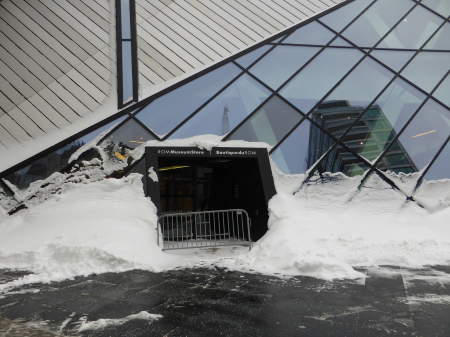
Architect Daniel Libeskind’s evocative design was supposed to bring more visitors to the ROM, but attendance is still lower than Montreal Museum of Fine Arts. The origami-like shape is not conducive to energy efficiency.

The only way Canada will achieve the 2030 Challenge goals is through better planning and physical testing. Specifically, very few buildings in Canada have their performance optimised in the planning stages using a computer energy simulation, and fewer buildings still are air tightness tested to meet a minimum air leakage standard.

ROM Upclose (Custom)

The ROM’s git shop having a bad snow day. The Crystal’s design ignores the reality of our current climate and as storms are predicted to get more intense, this design will surely mean more snow days for the ROM’s gift shop.

So, how does Canada stack up internationally? Did you know that Qatar, Latvia, Slovenia, and the Czech Republic have air tightness minimums for new residential construction? Did you know that Estonia, India, Lithuania and Scotland all have air tightness minimums for new commercial construction. Canadian architects require very little in their specifications when it comes to future resiliency and meeting the 2030 challenge. Better buildings require better planning and site testing and as time marches on, its become apparent that industry won’t do it voluntarily, it might have to be dragged kicking and screaming as mandated by building codes.

Are we Close to the Tipping Point?

200 blog posts into our 3rd year of incorporation and we’re still waiting for the other shoe to drop. Sure we’ve got bonnie Prince Charles, Pope Francis teamed-up with secularist Naomi Klein, the ‘leader of the free world’ Obama and even China pulling up its socks. Heavy-weight economists like Sir Nicholas Stern saying “The evidence on the seriousness of the risks from inaction or delayed action is now overwhelming.” We’re living in dire, yet exciting times with all the change happening.

If that’s not enough, the dashing Robert Redford’s covering our back while both Shell and BP are pushing for a carbon tax. Not to be outdone, the Dutch have successfully sued their government for greater action on Climate Change. Meanwhile Canadians keep trundling along like there’s no big hurry; a symptom of a resource rich country with nothing to lose. Enter stage left, the Saudi’s flick a switch cutting oil prices in half, and who would have predicted Alberta voting in a majority NDP government?

As I write this, California’s nearly out of water, Texas was flooded, Alaska’s burning, heat waves killed thousands in India and Pakistan, now Europe is baking in the sun. What will it take to spur action?

Before he passed away, Jim Flaherty naively admonished corporations for not re-investing profits into infrastructure, but asking industry to do more voluntarily is like pushing on a string. Industry unfortunately has to be goaded through regulation and Canada has a lot of catch up to do regarding energy conservation in the building sector. Here’s hoping we’re close to the tipping point!


Honourable Mention in EcoHouse Magazine!

Riding on Solares Architecture‘s coat-tails, BlueGreen Group was mentioned in SAB Magazine’s residential off-shoot Canada EcoHouse:


Solares Makes Headlines… Again!

A big congratulations to Solares Architecture for making headlines in the Globe and Mail yesterday. Once again, Solares shows that they are singularly focused on producing beautiful high performance homes and BlueGreen Group is proud to collaborate on the energy detailing for their projects.

In a day and age where art trumps functionality, it’s increasingly hard to get any press, but Solares manages it in this awkwardly titled article “Under the skin: How investing in the mechanics of the home will save money“. I say awkwardly, because, Solares tends to emphasise superb envelope detailing and de-empahsise mechanical systems. They do that knowing moving parts in mechanical systems breakdown, but a well built building envelope has few moving parts to breakdown aside from operable doors and windows. Writer John Bentley Mays might be catering to a high brow audience that he suspects craves art at the expense of functionality, sustainability and durability when he goes on to suggest “The office now needs to get busy with the art.”

We do a lot of diagnostics on building failures and I’d love to spend a day with Mays to talk about and show him how often ‘art’ fails, often dramatically, leaving really rich homeowners having to repair complex envelopes. I hope going forward he understands that complex envelopes require superb planning and detailing – which Solares excels at – and that the builder needs to be at the top of their game when assembling. It’s too bad that Mays didn’t talk to the client who commissioned the project in question or he would have quickly realised the client didn’t want art, they wanted performance.

Good work Solares!