
The idea with a deep energy retrofit is to renovate to such a degree where no work will be needed on the house for another 100 years or more, so when we gut old double brick homes, we often find the 2nd floor floor-joist are not as deep as the the main floor and after a 100 years of continuous service are a bit tired and sagging – its only natural.
In this particular energy retrofit, the wall studs were spaced off the double brick by about and inch (you pretty much have to space off the wall that much to account for inconsistencies in the brick) so that spray foam can form a “monolithic” coat underneath. We use the word monolithic carefully here as the spacing needs to be at least 2″ of free space to really get the foam in there. This comes with risks of bowing out walls if not tied back to the masonry mid-span. This job was fairly good with the exception of outside corners and floor joists that penetrated the foam.
Even still our testing routinely shows weakness in Deep Energy Retrofits where spray foam is applied to the brick. The air barrier is not the foam when its sprayed between framing members. Inn this case the air barrier was the brick the foam was sprayed on.
As always, the best investment is to test the insulation and air barrier system BEFORE the drywall goes on. Once the drywall’s on, its too late to seal.
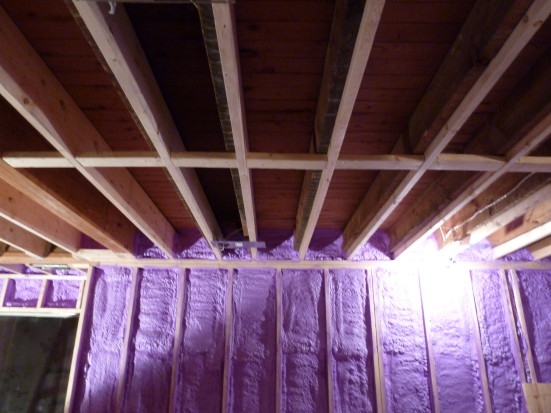
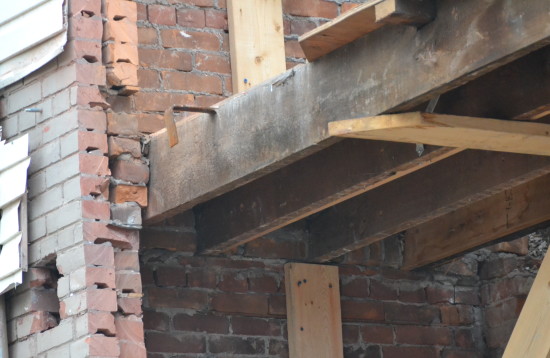
The original floor joists (dark with with lath marks) of this Toronto home’s second floor were undersized for the span and sagging by as much as 1.5″ mid-span. New, deeper joists were sistered to the original (light coloured new wood), the second floor lifted.
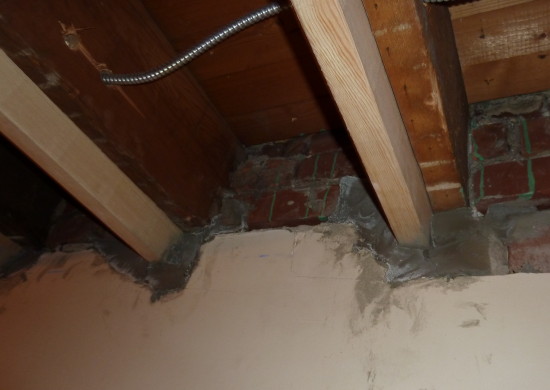
On the party-wall of this double brick home, the new floor joists bear in the brick and are packed with non-shrink grout. It pays to seal the party-wall not only to limit rodent passage, but to stop sound transmission and air leakage up and out the party wall.
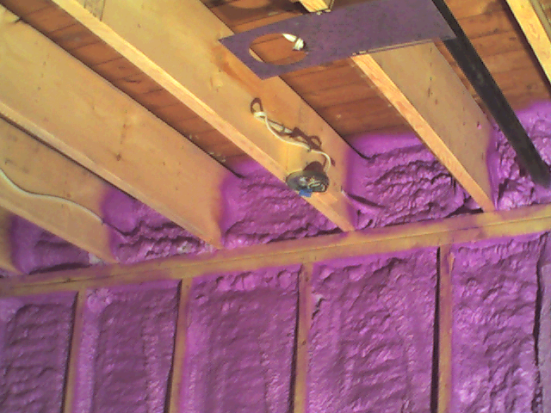
The newly spray foamed “rim joist” area has a few significant leaks; namely the gap between the old sub-floor and the new joist’s top as seen in the detail below and between the laminated joists.
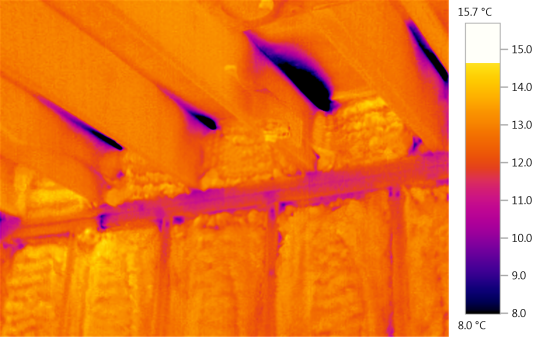
When depressurised, this leakage paths on this cold February day are highlighted as dark areas. The but-edge of top plates and the tops of the new joists under sub-flooring are hard to foam properly. The laminated joist (not shown) leak air between joists too.
The rim-joist is also an often overlooked area that is REALLY difficult to insulate properly. If you’re lucky the rim joist will be spaced 3″-4″ off the masonry wall and if that’s the case, clean it out and have it insulated.
This nice 2nd floor cut-away (thanks Christie Pits!) shows the double brick wall cross section and the joists. The rim joist in this case was practically touching the masonry, in this case, the rim joist may have to be orphaned and insulated on the face a difficult task that’s hard to insulated and air seal really well and begs the questions, why don’t we just insulate on the outside? Note the old-style sheer wall steel brick tie to tie in the front wall to the floor joist.