
In the late 1790′s Count Rumford was the top of his game and helped masons better understand how to make an open fireplace light more easily, produce less smoke on start-up and produce more heat. The Rumford fireplace became the State-of-the-art standard world-wide for a few centuries. Thank you for your contribution to humanity Count Rumford, but times have changed.
We’ve learned a few things since then and he’s our advice – if you’re renovating and wanting to save energy just get rid of the old masonry fireplace(s). No gas insert(s), no wood – what city dweller has time to schlep, cut, stack, store, move and move in wood- just add insulation right over top it and forget it ever existed.
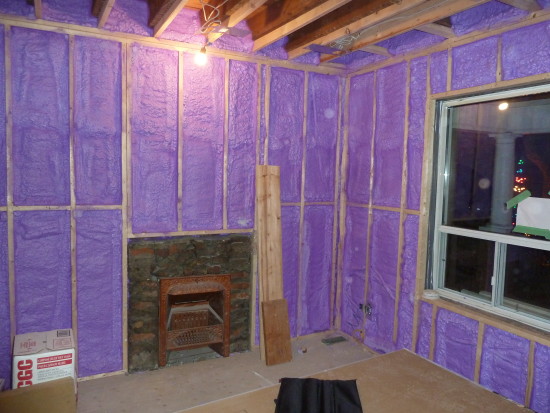
The open-faced fireplace is surrounded by new 2×4 wood framed wall insulated with spray foam (BASF Wall-tite) on a double brick wall. The studs were spaced away from the masonry to allow for a continuous layer of foam. Even still, the inside corner is notoriously difficult to seal and insulate because of framing. The same applies to the rim-joists.
When dealing with wood burning appliances the old chimneys often didn’t have a liner or flue pipe and so foaming on an active masonry chimney is dangerous for ignition reasons. Secondly, as in the infrared photo below, traditionally the hearth is the warmest place in the house, but not so when this house will be complete.
As the IR image will attest, the uninsulated brick and the air leakage through this cold area will condemn the owners to wearing shawls and toques! Unless this old 1790′s piece of technology is buried in insulation or is permanently fired up, this harbinger will clasp your limbs with its cold hands and fill your heart with regret for years to come as it becomes the greatest source of discomfort in you newly renovated Edwardian home on cold windy nights…
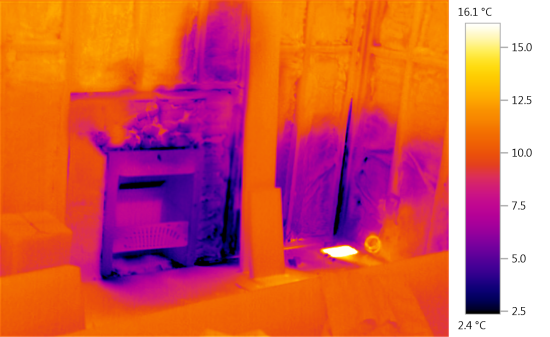
The open-faced fireplace is surrounded by new spray foam on a double brick wall. The drop in temperature (purple) around the Rumford fireplace is caused by depressurising the house; either way the fireplace is always a source o significant air leakage especially where the round flue passes through the chimney. Note the inside corner is notoriously difficult to seal and insulate because of framing and forms a black cold slit on the right of the image and at its base is the nearly white hot HVAC supply register.