Archive by Author

Home Ratings have Nothing on Fish Sticks

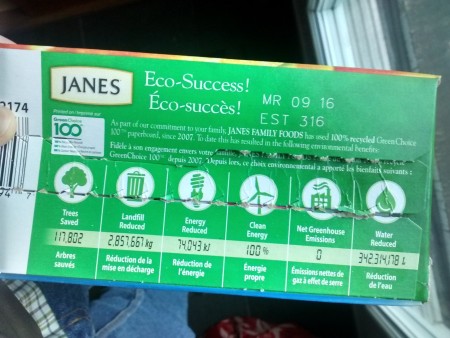
I picked up some frozen fish n’ chips’ for dinner the other day and was astonished, nay aghast at how detailed and thorough the pedigree on frozen fish sticks were!

It was actually for the box, not the sticks inside, but either way, it was good marketing for food packaging. If only we could get this kind of data on the waste associated with each renovation project or new build!

Fish sticks!


Just in: Climate-Specific Passive Building Standards

Producing energy optimised designs and construction assembly details for high performance buildings is too urgent and important to fight over who’s name gets on the wall plaque. In wanting to accelerate wide adoption of a significantly higher than building code energy performance standard for the North American market, the  Passive House Institute United States (PHIUS) tasked a volunteer Technical Committee in 2011. They have just released their highly anticipated Climate-Specific Passive Building Standards in conjunction with Building Science Corp through Building America.

Called PHIUS + 2015 , the technical document aims to find the “climate-specific sweet spot where aggressive energy and carbon reduction overlap with cost effectiveness” as opposed to the ‘one-size fits all’ PHI approach which highly respected industry professionals like GBA’s Editor Martin Holladay openly muse if some of the Passivhaus requirements are logical perhaps even arbitrary .

In a nutshell, the changes proposed for the new PHIUS standard follow the three pillars:

1. The air-tightness requirement was reconsidered on the basis of avoiding moisture and mold risk. The proposed change is from a limit of 0.6 ACH50 to 0.05 CFM50 per square foot of gross envelope area (or 0.08 CFM75). This allows the airtightness requirement to scale appropriately based on building size.
2. The source energy limit was reconsidered on the basis of the global CO2 emission budget. The following changes are proposed to make the scoring more fair and the calculation more accurate:

  • Change to a per-person limit rather than per square foot of floor area, for residential projects.
  • Correct the source energy factor for grid electricity in the calculation protocol to 3.16, consistent with the US national average.
  • Adopt lighting and miscellaneous-plug-load defaults at 80% of the Residential Energy Services Network (RESNET) standard.
  • Set the source energy limit to 6200 kWh per person per year, tightening to 4200 within a few years TBD.
  • Apply the limit to the source energy calculated net of the estimated fraction of onsite photovoltaic (PV) or other renewable electricity generation that is used onsite as it is produced. This accounts for PV the same way solar hot water is accounted for.

3. The space conditioning criteria were reconsidered on the basis of economic feasibility. The proposed change is to:

  • Shift to mandatory thresholds on annual heating and cooling demands and peak heating and cooling loads, climate-specific to a project’s location, which aim for a near-optimal “sweet spot” with slightly more energy savings than BEopt’s calculated cost optimum. This ensures efficiency measures will be reasonably cost-competitive, while providing some increased resilience benefits.
  • Adopt a simplified reference floor area – an inclusive interior-dimension floor area.

‘Passivhaus’ vs ‘Passive House’?

Influential eco-starchitects like Daniel Pearl of l’Oeuf have come full circle after 20 years of practice in admitting that the Passive House approach is where we need to go as a society in designing and building the next generation of buildings. The facts remain:

  • Germans and Americans don’t look at payback in the same way and they’re philosophical approaches to construction in general are an ocean apart.
  • In the EU, and Germany in particular, very few homes are actually certified as “Passive House” by PHI. There’s no need, home owners don’t need the plaque, they just want the performance.
  • Climate change is here and there’s an urgent call for higher building efficiency; that means the price of building materials and construction techniques needs to be ‘more’ competitive and the ‘one-size fits all climates’ PHI approach may be too rigid.
  • The great irony in all of this infighting is that even PHI is adding water to the wine with the introduction of three new certification standards  ostensibly to ‘certify’ more homes in America.
  • Meanwhile, NESEA’s Pretty Good House makes compelling arguments against PHI’s dogmatic approach if we want rapid adoption of a significantly higher performing homes to be built now.

The elephant in the room

Here’s what I know, German architect Katrin Klingenberg has been singularly focused-on and doggedly pushing the PH approach in the USA and Canada since the early 2000′s because she believes there’s an urgent call to action in building and retrofitting better. I’d attend most of her talks at Affordable Comfort Inc. and in the early days the audience was small, but over the years I watched her build and nurture an audience interested in what she had to say. This is well before a divisive Canadian helped trigger the current North American vs European schism, the result of which, is confusion in the marketplace and unnecessary division. Ironically, it may eventually might lead to wider adoption of a high performance standard that swings conventional builders over to the sustainable, high performance side and away from prescriptive code minimums.

The infighting in North America between the euro-centric approach versus the dynamic ideas offered by PHIUS does a huge dis-service to the rapid adoption and implementation of the principles of Passive House – both produce incredibly efficient buildings. I certainly understand the allure for American builders and architects wanting to differentiate their brand as “the sexy German sports car equivalent”, but let’s not forget the huge benefits of the old “Made in America” slogan.

The duplication is most hurtful in that both hold separate conferences in the US that are timed to divide allegiance. Thankfully, the Canadian NGO PBC has been steadily and magnanimously trying to push for an inclusive adoption of the principles of Passive House irrespective of the certifying agency, be it PHIUS or PHI.

The mudslinging goes on and until the kids can play in the sandbox together, they will be seen by the status quo as what they are – building nerds who are willing to split hairs over a few kWh, the messy exclusion of floor cavities and who’s name gets on the wall plaque. The world needs unity on tackling the effects of climate change – let’s build better with or without a certification, now!


Daniels’ Pearls of Wisdom at UofT B.E.S.T.

Daniel Pearl, co-founder of L’ŒUF (l’Office de l’Éclectisme Urbain et Fonctionnel), spoke to a receptive, standing room only audience of alumni, students and building professionals this past March 12 at UofT Daniels for B.E.S.T. Lecture. His talk was engaging, fresh and almost unexpected coming from the haloed ancient halls of UofT.

As evidence suggests, the schools pushing the envelope on energy efficiency include the University of Waterloo and Ryerson University, but maybe now, U of T can pick up its game with Mr. Pearl’s pearls of wisdom.

In the building sector, Toronto lags behind other North American cities in its push for high efficiency buildings. Suppliers seem to sell high performance materials to the rest of Ontario, but the city itself is stogy and stuck in its ways it seems. So too with its namesake university. In our experience, the architects pushing building envelope efficiency to the next level almost always come from Waterloo – perhaps because the school of architecture was born of shared roots with the department of the environment. But we digress!

Mr. Pearl tried to succinctly drive the point that after 20 years of trying to increase building energy performance from wild mechanical systems, to sophisticated envelope features – nothing beats the Passive House approach. Period. “People are not our Guinea Pigs!” he said of building public housing.

His insights were prescient in that he derives his opinions on data. He monitors his builds scientifically for performance and solicits information on comfort and use from the building occupants and with that information he’s come to the stark conclusion that people are too busy to manage or understand complicated mechanicals systems. Of course, the Passive House approach seeks to minimise mechanical equipment and emphasise superb building envelope design that’s simple, durable and elegant.

In closing he urged his UofT audience “We need to be re-educated.”  Which came as a bit of a shock, but was pointedly delivered to the people of his almamater.

Happy Persian New Year!

To all the Persians out there who have a punishing schedule this weekend vising relatives, eating kebabs and drinking; Sale no mobarak! To everyone else, Happy Spring! With mere minutes to spare before the exact (astronomically observed) vernal equinox and the sun at our backs, Friday afternoon seemed the perfect opportunity to uncork and drink the dregs of our office stash.

It’s a big event and the one tradition that brings Shervin the most happines. Shamefully, I have never done the jumping over the fire ceremony with Shervin (he never misses this dangerous feat) which just sound like the right thing to do leaving your worries, fears behind in the fire in preparation for the new year.


IMG_20150320_170410490

Shervin and I raise a glass* (sorry I couldn’t do the selfie thing and raise a glass at the same time!) to all of you wishing peace, happiness and prosperity.                                                       *This moment brought to you by Ed Marion who bought us the Bushmills (Black).


Vernal Equinox Signals End to Hunting Season

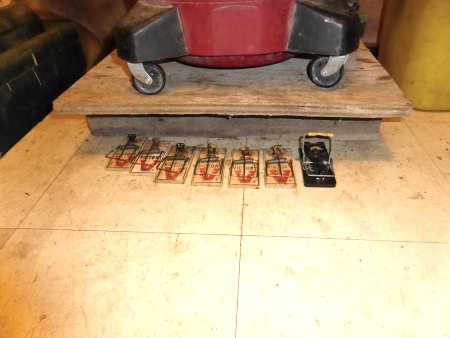
As winter’s grip slowly recedes and day wins over night, this is a friendly reminder that hunting season is over. You can take what’s already caught in your trap-lines, but with the summer warmth, those fuzzy mice have bigger fish to fry as they migrate outdoors to fatten up for next winter.

Let this be a lesson to all of you renovating an old house; this is your one chance to plug up those vermin holes with something durable and if mice can get in, your envelope has some holes that are consuming energy and cheese.

Happy spring!

P1010451 (Custom)

We recently did an energy audit on Mr. McGregor’s house who said “Though the winter was cold, it wasn’t a good year for trapping…” saying that he barely caught enough pelts to sole one slipper. McGregor went on to say he was looking forward to summer to finally catch that pesky rabbit Peter to sole his other slipper in one fell swoop.

Toronto’s Home Energy Loan Program to be Rolled out City-wide

The City of Toronto launched a financing program for incentivising Deep Energy Retrofits of existing homes called Home Energy Loan Program (HELP). As the link says “Low interest loans are available to qualifying homeowners who are interested in improving the energy and water efficiency of their home. Through HELP, the City will provide the funding required to complete the improvements and the homeowner will repay the City over time through installments on their property tax bill.”

Since roll out, 120 homeowners are in the process of renovating their homes and about 50 participants have completed their projects. Though not currently available in every area of the city, people everywhere are encouraged to apply in anticipation of a city-wide roll out.

The benefits of the HELP program include:

1. Avoiding the large upfront cost of home energy improvements and pay for them over time.

2. The fact that financing is attached to the property, not to the property owner. If you sell the property before the loan is repaid, the new owner will assume the balance of the loan and continue to repay it through the property tax bill.

3. The fact the loan can be paid off any time, without penalty.

4. The benefit from low interest rates and longer repayment terms, compared to conventional financing.

5. Incentives of up to $2,000 are available from Enbridge Gas, including a rebate to cover the cost of your home energy assessments. And an incentive of up to $650 is available from Toronto Hydro for replacing your furnace and air conditioner with high efficiency units.


HELP_logo4x6.png

BGG Blog Reposted on GBA!

Did we mention that our LED light Blog post was picked up and re-posted on the venerable Green Building Advisor? Yup, you can check it out yourself!

http://www.greenbuildingadvisor.com/blogs/dept/guest-blogs/new-led-lights-scene

As usual, I learned more from the reader responses … sigh… so humbling, so much to learn!


Success with our 3rd ‘High [Performance] Design Meets Boots on the Ground’

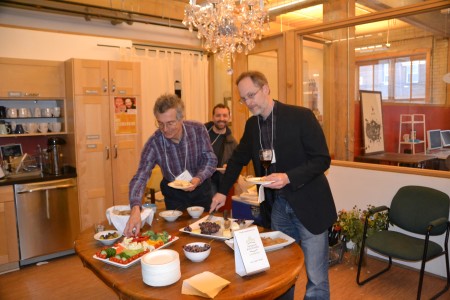
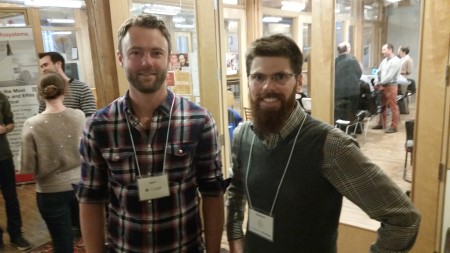
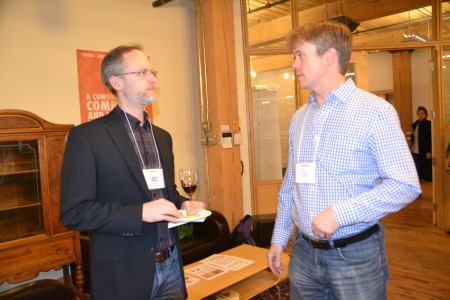
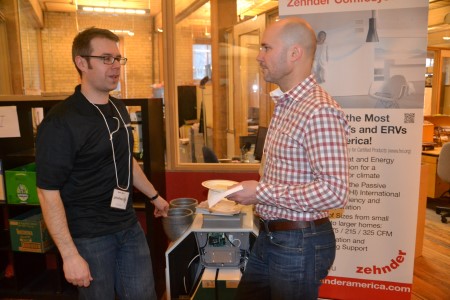
Our 3rd ‘High [Performance] Design Meets Boots on the Ground’ attracted a great mix of talented architects and builders who are squarely focused on producing high performance buildings. The insightful presentations were followed by what felt like a ‘homey’ kitchen party. Of course, it only works if people come and the people that did come were clearly glad to be there – so thanks for sharing your time with us.

Of course, it wasn’t all perfect and at each event something has to go awry, so if it wasn’t me forgetting the cheese and olives at home, or bringing straight pins instead of safety pins for name tags, this time it was switching off the motor for the auto focus on my SLR and foisting it on our communications pro Cheryl McNamara -sorry Cheryl! So if you look fuzzy below, it’s because you had a warm glow about you after sitting over an hour in the Bikram studio… er I mean the Whole Connector room. Yes always a bit warm but makes the refreshments afterwards that much more rewarding.

Again a big thanks to our presenters Steven Dennison, Patrick Andres, David Shephard and Shervin Akhavi, you did great work and of course, we thank the support of our generous sponsors Pinwheel Building Supplies, Greening Homes and Passive Building Canada.

So with even greater purpose, aplomb and confidence, we look forward to seeing the cream of southern Ontario’s high performance builders and architects at our next event this fall!


DSC_0354 - Copy (Custom)

Thankfully, these tall skinny guys were getting in on the food action! L-R Carpenter Peter Shepherd, in the background and always the ham Manny Neves of Hardcore Renos and engineer Andrew Hellebust of Riverourt Engineering.

DSC_0353 - Copy (Custom)

The Solares Brain Trust: Lilia, Jared and Josef.

DSC_0421 (Custom)

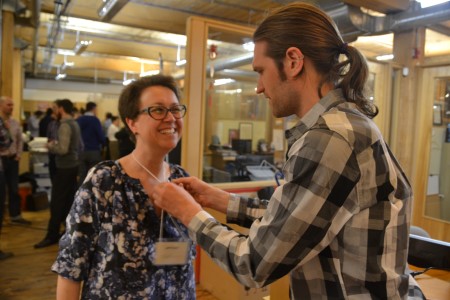
Cameraman Daryn Caister putting a shine on Bettina Hoar‘s name tag.

Patrick Andres and colleague (Custom)

Engineers and building scientists Matt Carlsson and speaker Patrick Andres.

DSC_0373 (Custom)

Don’t let this stodgy, stiff upper lipped photo fool you, Yonnas T. Yohannes of Solsmart has the character and warmth of the Buddha.

DSC_0410 (Custom)

Bettina Hoar with the sponsoring lads of Greening Homes Steven Gray (past presenter) and Chris Philips test some product from Pinwheel.

DSC_0417 (Custom)

Coolearth‘s Craig England chats with Oakville builder Mike Manning of Greenbilt Homes.

DSC_0420 (Custom)

High performance builders Graham Fisher (future presenter) shares a laugh with Sylvia Cook of Aerecura.

DSC_0372 (Custom)

Andrew Hellebust and Charles Bull (Bull Design Build).

DSC_0361 (Custom)

Sponsor Hans Eich of Pinwheel speaks with builder Todd Smith of Dept356.


Ode to a Flashlight

P1010479 (Custom)

Not merely a flashlight, but a lantern; thanks Mr. and Mrs. Ketchum!

I’ve been accused of spending lavishly on (many) flashlights and headlamps, but when the power went out twice in Toronto’s west-end  this past February, I could see everyone in the family appreciated the high quality lighting. And so today, when I came across this beaut, I felt a bit teary eyed thinking of all the rusty contacts I sanded, intermittent switches, burned light bulbs and weak, acid leaking batteries I tested with my tongue as a kid.

Making light is a wonderful thing and so it seems right that we pause and thank the torch with an Ode to the Flashlight by Vinny Casso:

A greater literary talent might write
It was a dark and stormy night.”

For that it was.  Ah, well I remember–
Twas the second week in a bleak December.

Odd that I recall the date with such clarity.
(Apologies to Poe for any similarity.)

The winds were howling.  My cats tried to hide.
Garbage cans rolled in the lot outside.

The windows rattled.  The storm doors shook.
I turned on the TV and put down my book.

I was wrapped in my afghan as snug as could be
while a little pink bunny marched across the TV.

It must have been close to eleven o’clock
when the transformer blew on a pole down the block.

The night went black with a thunderous boom.
My only flashlight was in an upstairs room.

Twas black as the proverbial Halloween cat.
(Being afraid of the dark, I couldn’t have that!)

So, I groped and crawled my way up the stairs
with choked-back terror, a few muttered prayers.

Then tripped near a wall-shelf beside my bed.
The flashlight toppled and struck my head.

Still, that was OK;  I had injured myself,
but at least I could now find the medicine shelf!

So, bandaged and shaken, my stomach now churning,
I settled in bed with my flashlight still burning.

I hoped the bunny on TV was right.
And he was.  It burned the rest of the night.

So, in retrospect, I later decided
to honor the comfort my flashlight provided.

Something light-hearted.  (Please pardon the pun.)
But ‘You light up my life’  has already been done;

So, with apologies to Keats, Longfellow and Plath,
little blue flashlight, YOU LIGHT UP MY PATH!



P1010480 (Custom)

A retrospective: A thing of beauty, the Delta Powertop Lantern.



Convincing Home Owners to Upgrade Efficiency


Empty glasses and empty promises for vertical integration and a national energy industry. I spent the dog days of summer ’88 pumping gas at Petro Canada and handing out all manner of commemorative glasses – the price of gas today is about the same as it was back then.

As I write, the price of gas at the pump sits well under a dollar a litre which is about the same price it was when I worked a summer at Petro Canada slinging gas at the pump. The price of delivered natural gas is about 32 cents a cubic meter and with these low prices, the financial incentive to conserve is low on the list of priorities for many Canadians. What humbles me is the fact that I can hear myself repeating to homeowners throughout the early and mid 2000′s “Mark my word, the price of energy will go through the roof!”

Though electricity prices have steadily risen, my words have come to haunt me in that prices are still low, especially for natural gas, to the point where I should wash my mouth out with soap – but my, the House of Saud keeps us on our toes! So what’s the incentive for home owners to build a home that’s significantly better performing than building code minimums? More to the point, how does one convince a client to invest in efficiency? Baring the moral issue, it’s the right thing to do for durability, health, low maintenance and increased resilience to natural disasters, but how do we convince owners who are on the fence?

It’s a question Micheal Maines (from Maine!) tackles in a recent Guest Blog posted in Green Building Advisor titled Convincing Clients to Upgrade to Pretty Good (or Better). Because we deliver services to other businesses, we don’t often have to deal with the building owner and thankfully, eschew many of the hard questions we once had to answer on a daily basis when we delivered home energy audits for government rebate programs. Still, there are solid points to be made.

Jim Bahoosh of Jim Bahoosh, Builder —  suggests that “no frost on [better] windows” and that energy audits for those considering a full gut/reno should be mandatory. Chris Briley of Briburn Architects, and great podcast Green Architect’s Lounge suggest using “science” and to spend on ventilation. In the end all agreed, that making it beautiful was essential.

At BlueGreen Group, we couldn’t agree more and always emphasize hiring an experienced architect who can walk the razor’s edge pulling between doing what’s right and the ‘house porn’-like expectations of what we’re told we need. A good architect will provide a builder with details needed for high performance and should make the house beautiful for generations of easy and loving low-maintenance.

We also believe that science and detailed energy modeling informs the decision making process, keeps the ‘gut feeling’ in check and simplifies decision-making. This applies to both new construction and Deep Energy Retrofits of existing homes.  Let the data talk, but beware, as the old saying goes “Garbage in, garbage out” and the person doing the energy modeling needs to know how to process data with the software.

The other thing we’ve learned is that doing a pre-drywall air tightness test is crucial. In 2012, the Ontario Building Code changed and now building inspectors are compelled to “inspect” the air barrier and sign-off. This sounds rigorous, but is really toothless. Inspectors should be TESTING the air barrier. That’s where we come in with our equipment and help builders get more value from their sub-trades especially the spray foamers who often miss spots, unintentionally skimp on thickness or in rare cases go off ratio.

So until building inspectors test building shells with a blower door, take quality and performance into your own hands and TEST the building BEFORE the drywall goes on. This simple 3rd party test can save you lots of grief in the long run and ensure the home owner is left with lasting beauty no matter which way energy prices go. To those of you who already know the value of testing, not just ‘inspecting’, we raise a full glass to your continued health!