Archive | Blog RSS feed for this section

New LED Lights on the Scene!

In 1999, I went through the back service doors of Wolf Electric on King St. just West of Bathurst and fumbled my way along the poorly lit, uneven floors to drop $37+tax for one compact fluorescent light (CFL) bulb made by Philips. It was the start of energy efficient lighting and quite possibly the apogee of CFLs given that store shelves today are littered with crappy CFL lights that aren’t dimmable, are filled with hazardous mercury and the ballast produces so much waste heat that the white plastic base quickly gets cooked to a yellow crisp as they sputter to an early death. So much for energy conservation.

But hang on… Is it just us, or did 2015 just usher in a new era of LED lighting? It seems LED’s have jumped out of the dark ages by offering dimmable features, lighting systems that tie into home automation to change hue from your smart phone, produce a truly beautiful light that doesn’t oscillate and one can read a book ( durable, sharable, battery-less device made of bound paper having stories printed in ink ) and lets not forget the fact that these lights “could” be substantially more durable than CFLs without mercury.

As you well know, pot lights installed through the top ceiling’s air barrier have been a big pet peeve of ours, not because we don’t like the lights, but because they kill home performance. The great news is that a series of new LED lights have flooded the market recently which might be able to significantly reduce heat-loss through air leakage.

Surrey BC company Lotus LED Lights has been retailing some exciting low profile pot lights that could substantially reduce the fussiness of installing pot lights. It should be noted that good quality LEDs typically have aluminum heat sinks and for good reason; the heat needs to dissipate so take this next sentence with a grain of salt. These new lights could potentially eliminate the need entirely for the large housing box that punctuates the air barrier system and projects into the attic to disturb uniform, continuous insulation and leak conditioned air like a sieve. Sadly, many electricians don’t get air sealing but these new faux-pot lights might be able to help them because many models install directly into a regular octagonal junction box*. That simple!

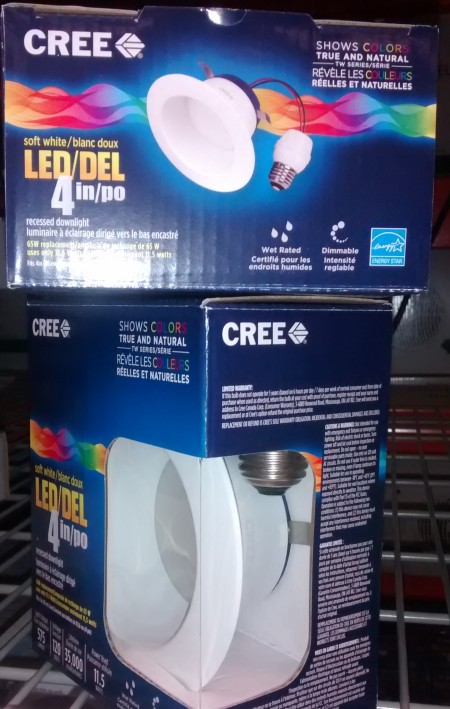
What’s really exciting is that there may be a retrofit opportunity to easily air seal 90% of air leakage that occurs through pot lights by simply installing a new type of LED. Coming from a guy who made a living by sending other guys into hot, itchy attics to air seal the backs of pot lights – this seems like a no-brainer retrofit solution:
LED 2

If the flange assembly of this LED light is air tight and if it can be installed tight against the drywall, or existing metal flange, this might be the easiest retrofit for pot lights in the world and a steal at $35-$45 apiece when compared to sending a guy up into the attic to retrofit a drywall box or plastic VB boot around the leaky IC rated pot light box.

LED 1

Dimmable and looks like it might form a better air seal at the ceiling flange than conventional light bulbs, plus it gets the ENERGY STAR logo!

I’m proud to say that the same Philips CFL light bulb I bought in 1999 has been on a motion sensor in my back yard – extremely exposed to the elements protecting us from marauding racoons – for the past 10 years and is still going strong. My money’s on Philips for their commitment to quality and durability in this next wave of LEDs.


*This blog was re-posted on GBA with some amazing reader comments. Further to this post, High Performance Builder Steven Dennison (Dennison Homes) tried out this Philips product and was really impressed by the light quality and the simplicity in that it DID fit into a regular octagonal box!

 

Commissioning ERVs

We were recently called to commission a fully ducted heat recovery ventilation system in a house. The commissioning process was based on CSA-F326, Residential Mechanical Systems to ensure the system didn’t change the pressure in the house and to adjust flows room by room according to the intended mechanical design. In this case the ERV in question was an Enthalpic or Energy Recovery Ventilator (ERV) and what we thought was going to be a straight forward job turned into a multiday, time gobbler that taught us a few lessons.

At risk of stating the obvious, mechanical ventilation systems will either pressurise a home or depressurise it if not commissioned:

The house in the middle is “just right” and had to be commissioned to confirm the ventilation system was “balanced” – that is the pressure inside the house is the same as outside. The house on the left with a “blow only” ventilation system is pressurising the house and possibly driving humidity into the building envelope – which can cause condensation leading to mould, whereas the house on the right with the “suck only” system is pulling in cold dry air from the outside when it’s on.

It should also be noted that NO ONE designs or installs HRV or ERV thinking it might need to be commissioned before occupancy. Typically these units are tucked high into a corner of the basement mechanical room with flex-duct contorted and crammed on all four stations. On flow accuracy, doing a transverse with a Pitot tube comes in 3rd, followed by the more convenient insert type linear type flow measuring station which would come in 2nd place and of course, the best is to install a four quadrant flow measuring station despite the labour involved to re & re.

Lab Setting for ERV

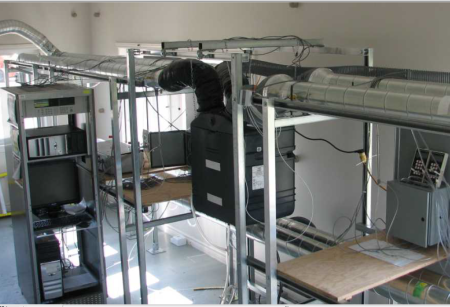
NRCan shows above what the Laboratory set up looks like. Replete with flow straighteners and nice straight lengths of duct before the taps – it won’t look like this in the field.


Real HRV - Not bad for Straight runs

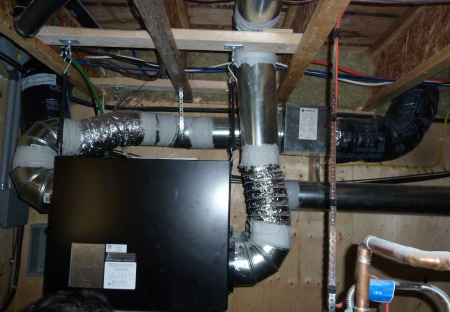
Typical HRV with OK access to ducts.


Real HRV

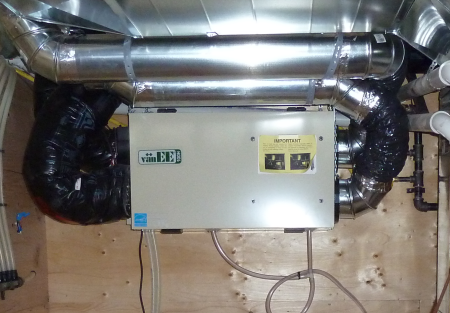
Typical ERV installation with constrained access.


The four quadrants of the ERV for the correct terminology. Thanks AHRI.

So we proposed another method or measuring total air flows. In speaking with the top scientist at ACIN in the Netherlands about our method using the FlowFinder Mk II, it was suggested that the error of the method proposed below could be a bit higher than 3% which given the alternative sounded acceptable and well within CSA-F326 10.2.1′s suggested -+15%!

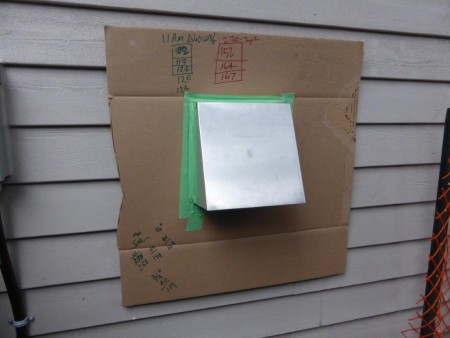
Exhaust Dec 23 2014

Stations 1 & 4 were the same shape. We taped the cardboard flange to the perimeter of the vent in order to get a reasonably good seal with our balometer. The back-draft dampers were not in the hood, but in the duct. Three sequential measurements were taken to account for potential errors due to wind.

So armed with flow measuring stations, Pitot tubes and our new balometer, we started measuring to find where our TVC might be on the variable speed control board. This would then allow us to adjust flows room by room, except that the flows in and out of the house were off. Way off. They were off at Stations 1 & 4, they were off at Stations 2 & 3.

There were no adjustable dampers for this ERV, so we changed jumpers on the mother board and started undoing duct-work to check that inline back-draft dampers were OK. Still, the flow rates were impossible. We were getting in some cases over a 100cfm more exhaust air (Station 4) than outdoor air (Station 1) and no HRAI ventilation course could have prepared us for what we went through.

In the end, common sense prevailed over a few weeks. Using a Watt meter, we diagnosed something the matter with the control board. The board was replaced and things were better but still not ideal. In the end technical literature suggested that it was common for ERVs with a media wheels to mix in extra ‘purge’ air to combat cross contamination which might explain our difficulties.


Are fan motors blowing air through the media filter or drawing the air through it?


Net result

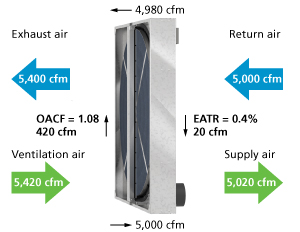
Clearly numbers for a commercial system, but Venmar shows graphically the relationship between air flows.


By design, this meant that flow at station 1 wouldn’t  equal flow at station 4. The ratio between those two flows is called the Outdoor Air Correction Factor (OACF) which ideally should stay as close to 1.0 as possible. There’s another cross contamination measurement called the Exhaust Air Transfer Ratio (EATR) -  the ratio of the exhaust air transfer to the supply flow rate.

The ERV in question was tested in ‘general’ accordance with CAN/CSA-C439-00, Standard Methods of Test for Rating The Performance of Heat Recovery Ventilators. The OAFC wasn’t available, but the EATR was calculated at 0.09, which according to the manufacturer, translates to about 3% of exhaust air being transferred into the fresh air stream. In other words, if we wanted 100cfm of fresh air delivered, we’d have to bump it up to 103cfm.

This might work in the lab, but not in the field where we were getting differences of 100cfm possibly due to a large OACF, possibly due to the home’s unique, custom duct work and or the added resistance of a pre-heater. Although the ERV in question was tested to CAN/CSA-C439-00, it wasn’t listed as HVI Certified (AHRI if a commercial unit).


In the end, we went with our DG700 and measured the pressure across the building envelope to ensure the system was ‘balanced’ when the ERV was running at TSV. CSA F326 states that flows in and out must be within 10% of each other and typically the flows are measured at stations 2 & 3 if the duct work will allow.

The lessons learned included ensuring the mechanical designer selects an AHRI Certified model and that the heat exchanger core uses a membrane that prevents cross contamination. Measuring flows at stations 4 & 1 or 2 & 3 gave meaningless data because we didn’t know how much of it was due to cross contamination. We were better adjusting flows room by room, then simply ensuring the house pressure was neutral at TVC. Having witnessed the build at the bare duct stage, we knew duct leakage wasn’t an issue, though we could have tested for it. We’re certainly going to ask builders to start supplying a chunk of straight pipe and flow measuring stations at Stations 2 & 3 from now on.

Though it probably applies more to commercial systems, Venmar suggests “If OACF is ignored in the selection process, then the prescribed amount of fresh air will not be supplied to the space and poor indoor air quality may result—in addition to creating numerous potential issues with balancing and commissioning.” and we’d agree on the point about commissioning.

For a through treatment the calculations and explanation of jargon above, AHRI’s How ERVs Work section is brilliant. I’d also recommend downloading and reading NRC’s pdf for insights into the testing process: Evaluation of IAQ Impact of Balanced Residential Ventilation devices that incorporate HRV and ERV.


Ventilation for a Cold Canadian Climate

In Ontario, sadly, the residential building code still allows for cheap and infective ‘exhaust only’ ventilation systems and as Joe Lstiburek says, these systems suck – literally and figuratively.

OBC 9.32.3.4 Principal Exhaust“VENTILATION FAN” This system only sucks"

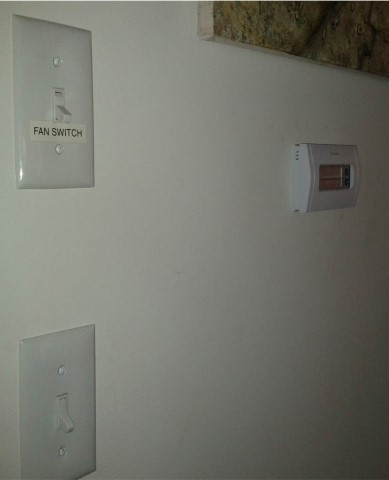
The sign of a cheap home: The photo above shows the wall in a typical living/dining room with artwork, a thermostat, a light switch and “FAN SWITCH”. Though declining in popularity since 2012, the Ontario Building Code section 9.32.3.4 still allows suck only systems as long as they are labeled “VENTILATION FAN”. This switch controls a bath exhaust fan one floor above. Make sense?

As the number of quality homes increase in the marketplace and get more air tight, “Suck only” ventilation systems are not being installed as often, but being replaced with systems that “recover” heat or reject it depending on the season.

Home with exhaust only ventilation systems e.g. bath fans, range hoods – exhaust only ventilation is about as effective as the old “Shut the Front door!” technique.

When compared to “Exhaust only ventilation” systems, ERVs and HRVs save energy by recovering conditioned air temperature.

Once properly adjusted or commissioned, the best ventilation systems don’t affect the pressure inside the house and the debate turns to Heat Recovery Ventilators (HRV) versus Enthalpic Recovery Ventilators (ERV).

Both ERVs and HRVs recover heat (sensible heat recovery), but what separates ERVs from the more common HRV is the fact that only ERVs maintain humidity levels (latent recovery).  Retaining humidity levels indoors at the ideal range of 40-50% RH in cold climates is difficult if a ventilation system needs to run continuously and doesn’t have latent recovery like the ERV does.

This trusty old Health Canada graph shows just how beneficial indoor humidity is toward human health with the optimum zone of humidity between 40% and 50% Relative Humidity.


Moist air has more energy than the same volume of dry air – so it only makes sense in super-efficient homes to try to keep that “energy” or moisture inside – or outside – depending on the season:


With an Enthalpic Recovery Ventilator, both the sensible heat and the latent heat is recovered from the air which tends to yield more savings, greater health and better comfort. Net result – humidity stays indoors.


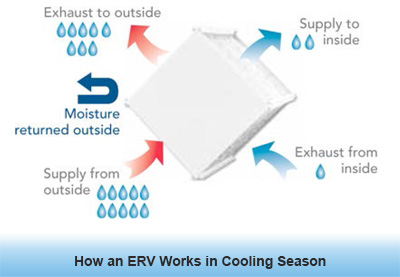
ERV ooling

In summer time, the ERV works to keep the humidity OUT of the house which helps the Air Conditioner keep the air cooler with less work than say an exhaust only system.

This energy/moisture is what building scientists call latent heat. Latent heat is the energy stored in water dissolved in the air and by keeping it indoors, we not only save more money in conditioning – read heating or cooling -  but we also stay more comfortable and healthy.

The evidence so far suggests that people living in air-tight homes situated in cold climates tend to dry-out their homes if running an HRV, however homes with ERVs and poor performing windows tend to get condensation forming at the window’s edge.

When it comes to the “heat exchanger”, residential ERVs come in two varieties– either a sealed system that works using a semi permeable membrane or a permeable filter like wheel. The sealed system works much like most HRVs using plate heat exchangers that are numerous and closely spaced but the great advantage with this system is the air tight separation between the stale air and fresh air. The membrane in this case is permeable to humidity. The later system with a media wheel rotates through the alternating air streams of fresh and stale air and though these systems work well, there is always some cross contamination between streams.

To minimise the cross contamination through ERVs,  at the very least ensure that the unit you select is listed in HVI’s List of Certified Products.


Endura Z-AC’s new Door Weatherstrip


We were recently at one of Solares Architecture‘s projects and leave it to them to find all these cool new building products. Having personally weatherstripped as many as 200 doors, I thought this product looked effective and rugged enough for the repeat abuse a threshold takes.

Have a closer look at ENDURA‘s new Z-AC below:

Sprayfoam Substrate Evenness Matters!

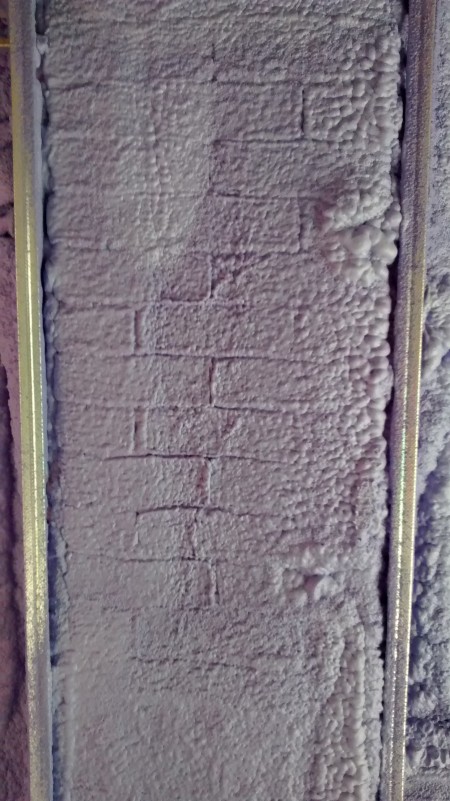
The masonry column below was sprayed with 2″ of 2LBS spray foam, yet one can clearly see all the mortar joints telegraph through the spray foam. The point is, that spray foam is incredibly sensitive to changes in substrate and spray foam’s thermal performance is tied to how voids in the foam that can either reduce the R-value or contribute to air leakage.

Wires, pipes, cables, framing members all have an impact and ideally should be kept to a minimum and at the very least tied to the warm side of the substrate so the rising foam doesn’t pull it out or create weaknesses in the thermal envelope.

Foam telegraphing

Are you Getting Enough… Fresh Air?

In a confined space I can survive 3 days without water, but only minutes without fresh air. So which is more critically important air or water? I try to drive this concept home in many of the technical talks we do for professionals who design and construct homes. Ironically, gauging by what North Americans spend their money on, it’s clearly not fresh air, but bottled water.

Bottled Water

You know who you are! Schlepping expensive bubbly water from Italy, maybe some still water from France – you can afford fresh air, just drink tap water!

Old habits die hard in a country where fresh clean water abounds. My goal here is to convince homeowners and professionals that they should take money earmarked for bottled water and invest it in a balanced, commissioned ventilation system for their home. Let’s clear the air a bit shall we?

What is “Fresh Air” anyhow?

“Fresh air” is defined by building scientists not by how much vital oxygen the air contains nor by how high the CO2 levels are, but rather by how fresh it “smells”. Outdoor atmospheric oxygen levels are at about 21.5% and CO2 rarely above 400ppm where IAQ guidance documents establish a recommended limit of 1000 ppm in indoors. Still, the canary in the coal mine is smell, if the air smells “off” it’s time to ventilate – In with the good, out with the bad!

What’s the proper ‘dosage’ for fresh air?

Like the rate of drinking 8 cups of water/day keeps you healthy, there’s a specific rate for ventilating a room for optimum health too. By ‘ventilation rate’ we mean bring in a specific ‘dose’ of fresh air per person per minute and ideally exhaust the same amount of stale air. As Dr. Joe Lstiburek puts it ever so succinctly in BSI-069 regarding mechanical ventilation:

  • “Blowing is better than sucking” – because blowing mixes air in the room.
  • “But if the only option is sucking over nothing, then suck. Sucking still sucks, but it is better than nothing. But remember you need to suck a lot and sucking a lot has its own problems.” Sucking only systems, bath exhaust fans for example, depressurise homes, sometimes to dangerous levels if combustion appliances like open-faced fireplaces and low or mid-efficiency furnaces or water heaters are in a tight house.
  • “Sucking and blowing at the same time is better than blowing.” In other words, balanced ventilation systems keep the pressure in the house the same as outside of the house and ensure a specific ‘dose’ of fresh air.
  • “If you then add energy recovery you are over the top.” For example HRV and ERV as opposed to relying solely on kitchen range hoods and bath fans.


How Much ‘New’ air keeps it ‘Fresh Smelling’ ?

We recently toured the Odour Lab at PINCHIN Environmental in Mississauga and they will confirm that the human nose is an incredibly sensitive instrument for detecting very small odour concentrations. So it begs the question, what’s the ventilation rate for each occupant? Turns out in a regular sized home the ‘dose’ of new air needed to keep the air fresh it’s about 10 cubic feet per minute per person. That’s a bit more than 10 basketball’s volumes worth of air for each person every minute. That translates to 30 litres per minute of new air per occupant coming into the house.

As per the good Doctor’s instructions above, the ideal system brings in and distributes fresh air while exhausting stale air from the worst rooms (bath, kitchen, laundry and hockey bag room),  recovers heat and humidity.

Brewing High Performance in Creemore!

Creemore – “Big Heart” in Gaelic –  is of course the home of the eponymous delicious Kellerbier and will soon be graced by one of this province’s most efficient homes!

The owner and builder Graham Fisher, a long-time home energy auditor and detailed energy modeller teamed up with an architect to design and optimise the house’s efficiency and if the desired air tightness levels are reached the heating load is expected to be well below 10,000BTU. What’s unique about this house is that though Graham is the GC, he’s technically never built a home, but like us, has been on construction sites observing building details for years. This has led to some very interesting innovations and a unique approach to building details of which I hope to not spoil here for Graham!

How did he do it?

The home has a simple shape, a double wall system, no basement and will have gorgeously large windows that will bring in the sun’s heat during the cold sunny days of January and February. I’ve included a few photos of what he’s doing in this post, but won’t steal all of Graham’s thunder as he’s poised to present at our fall Boots on the Ground Meets High Design session October 6th 2015. Suffice it to say that like the brewery next door, Graham’s unofficial motto seems to be “If something is worth doing – it’s worth doing well.”

P1000982 (Custom)

GCs Graham Fisher and Ed Marion stand out front on a crisp January day. The Northern elevation shows the air barrier sheathing prior to being taped so that Graham can air tightness test his house the same way Adam Cohen does it – before the windows are in.

Foundation Insulation (Custom)

Prior to back fill: The insides of the “basement” walls are lined with two layers of Type IV EPS, then back-filled and compacted for the new slab on grade. Credit: G. Smith

P1000985 (Custom)

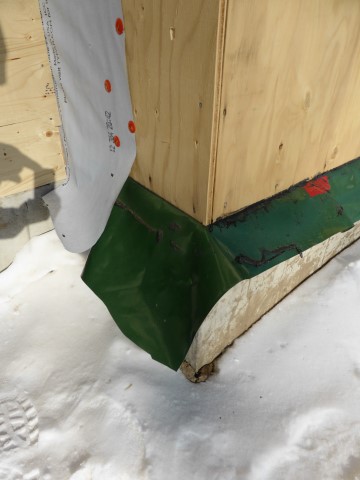
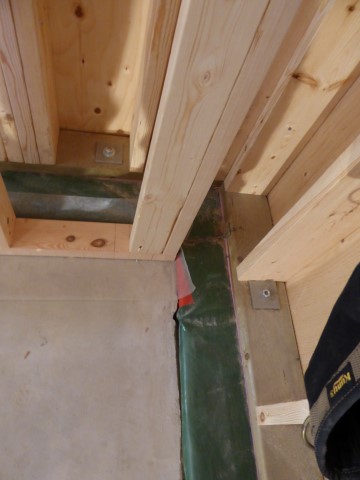
This outside corner detail shows the heavy green poly (16mil?) that will tie in the plywood exterior air barrier to the subslab and stem wall insulation layers.

P1000988 (Custom)

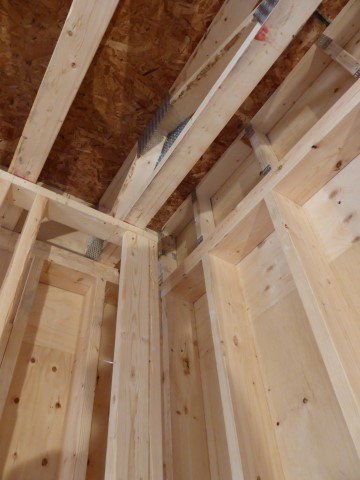
Looking onto the slab on grade, this inside corner shows the completed exterior walls and interior walls being built progressively. The green poly covers the top of the stem wall and it’s layers of EPS. The wall will be dense packed with cellulose in line with that thermal break between the slab on grade and the stem wall.

P1000989 (Custom)

Looking up at the long spanned deep engineered wood floor joists, with exterior structural walls completed and a second wall system being installed. The engineered floor joists allow easy installation of mechanicals, electricals and plumbing and offers long clear spans on the main floor.

P1000999 (Custom)

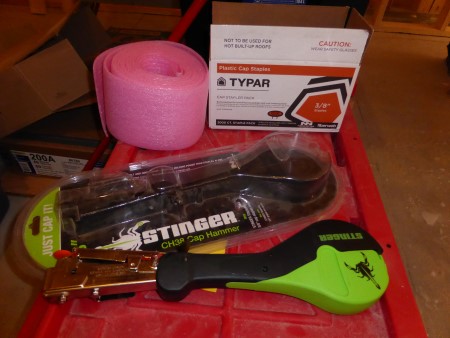
Graham showed us “The Stinger” used for fastening building paper with a protective cap reducing tears in the WRB making it less susceptible to wear and tear from weathering that happens prior to siding getting installed.

2015 Augers Well for The Planet

And 2015 is off with a bang! As the divestment movement takes root, oil and gas companies are being hammered by low oil prices all the while NAFTA’s wagging its finger at the oil sands and solar PV prices are dropping which yield returns that beat most RSPs.

If it’s not Stanford University faculty urging divestment of fossil fuels it’s Mexico and the USA tag-teaming it through NAFTA calling for a closer look into the effects of massive areas of tailings ponds seeping into the heartland of rugged and beautiful Alberta. Of course, Calgarians – like anyone – are enjoying the cheap road trips, but it’s a double edged sword as Shell cuts its workforce by 10% and the falling oil prices threaten to carve an estimated $11billion from Alberta’s provincial coffers if prices stay low. Didn’t this boom bust thing happen in the early 80’s:

The Calgary Heralds classified section bulged with homes for sale, sometimes including the contents and cars. The city had 2.3 million square metres of vacant office space, and its real estate speculators and oil investors had reverted to their former careers as teachers, dentists, and taxi drivers.

We’re at a turning point, where according to Dr. Jeremy Leggett, one large oil company is poised to turn it’s back on fossil fuels faster than police at a NY funeral and jump into renewables with both feet. He goes on to say “One of the oil companies will break ranks and this time it is going to stick,” he said. “The industry is facing plunging commodity prices and soaring costs at risky projects in the Arctic, deepwater Brazil and elsewhere. Oil companies are also realising it is no long morally defensible to ignore the consequences of climate change.” Leggitt even has the Pope on his side with the UN covering his back with a swan song from Ban Ki-moon.

So we raise a glass to you in anticipation of all the good work that will happen in producing near passive homes that won’t have to be renovated in a 100 years. We look forward to growing with you.

All the best in 2015!


Air Tightness Testing Commercial, Industrial and Institutional Buildings

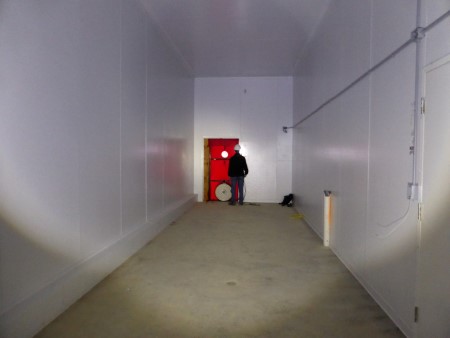
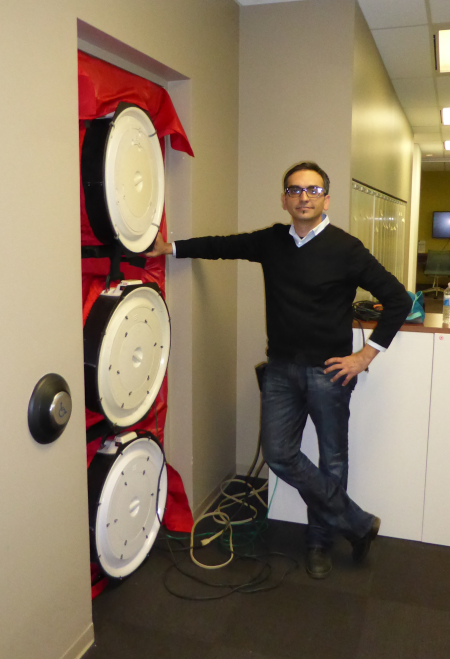
BlueGreen Group has just recently invested in the technology and infrastructure needed to test all manner of highrise, production, commercial and institutional building envelopes for diagnostic purposes or simple air leakage quantification. Our multi-fan apparatus can help us quantify and distinguish air leakage occurring between shared walls (guarded testing) from exterior walls.

Here are some of the building types and scenarios we’ve tested.

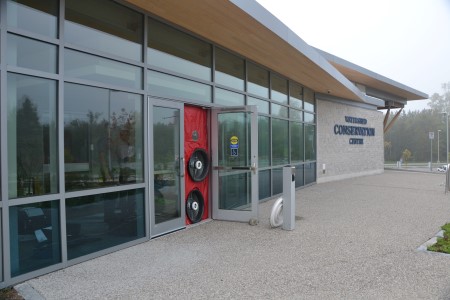
BGG testing the new LEED Platinum Watershed Conservation Centre on Fanshaw Lake.

BGG testing the new LEED Platinum Watershed Conservation Centre on Fanshaw Lake, London Ontario.

Commercial growing facilities need to control contamination between plants varieties in different rooms. Having air tight growing facilities ensures that pathogens, parasites and

BGG testing commercial plant growing facilities need to control contamination between growing rooms. Having air tight growing chambers ensures that pathogens, parasites, bacteria and viruses harmful to the commercial crop stay contained to one room and don’t spread to other growing rooms potentially destroying a harvest.


LEED ETS testing for high rise condos.

BGG doing LEED ETS testing for high rises ensuring condo owners won’t be affected by neighbours’ second hand smoke.

Office towers ii

Shervin depressurising one floor of an office tower to do envelope diagnostics.

Centre for Urban Ecology

BGG tested Humber College’s Centre for Urban Ecology, a LEED Platinum Building.


LEED EQ Prerequisite 2 – Controling 2nd Hand Smoke in High Rises

Need LEED certification for your condo under EQ Prerequisite 2? We’ve got you covered!

If you’re not a smoker nothing’s more stressful that the smell of 2nd hand smoke in your home, especially if you’re trying to quit or have a young family. It’s one thing in a semi-detached home when you only have one neighbour to deal with, but imagine if you’re in a high-rise condo – depending on where your unit is located, you could have as many as 4 shared surfaces and as many as 8 adjacent units – so the potential for smoke getting into your unit is higher.

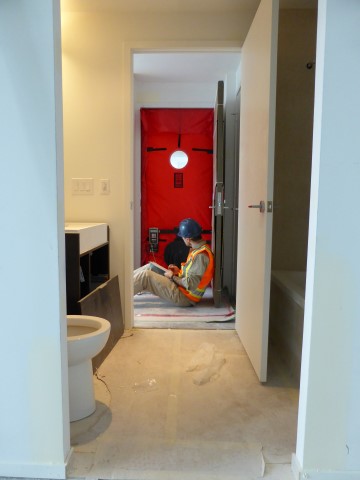
Running the numbers on the 28th floor overlooking the lovely Toronto skyline.


It’s for this reason that LEED certified residential buildings have more stringent requirements which severely curtail the potential of tobacco smoke from traveling unit to unit and they do this by requiring that every penetration between units is air sealed really well BEFORE THE DRYWALL GOES ON. The LEED Canada NC CS 2009 standard sets out specific testing that’s relatively easy test to do  - when Mother Nature co-operates – especially for units above the 20th floor!

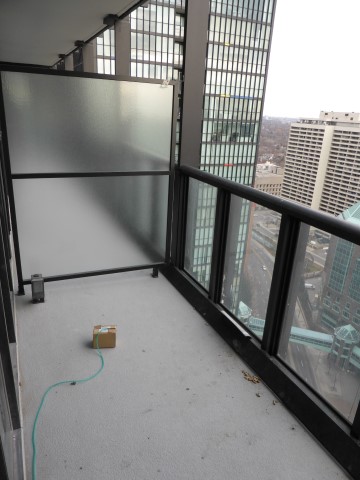
Because we’re measuring down to 1/10th of a Pascal, our incredibly sensitive micro-manometers require an experienced, steady hand to produce repeatable data. LEED allows either ASTM E779-03 Standard Test Method for Determining Air Leakage Rate by Fan Pressurisation or CAN/CGSB-149.10-M86 Determination of the Airtightness of Building Envelopes by the Fan Depressurization Method as a test method – both produce the same results and are equally stringent. Both test methods are sensitive to wind outside which can impact the quality of the test. Both test methods involve setting pressure taps on opposing sides of the building to neutralise the effects of wind as gusts typically hit the building at irregular intervals with varying intensity.


LEED ETS 2 (Custom)

Setting the “tap” lines… to neutralize the wind’s pulsing effects on small pressure measurements. Here we see the hose’s end tucked into a box to dampen the gusts. Another tap like this is placed on the opposite side of the building.

LEED ETS i (Custom)

With our new Duct Blaster, getting around the construction site is significantly easier than with the  larger Model 3 fans.